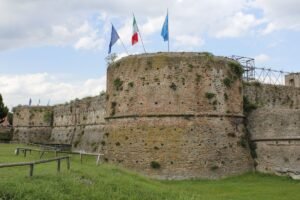
Perched on a hill in the upper Taro Valley, Compiano Castle is a thousand-year-old fortress that today combines history and hospitality: among its antique-filled halls, the International Masonic Museum and the wall walks, you can breathe in the Middle Ages. Below the walls, the village of Compiano is part of the ‘Most Beautiful Villages of Italy’ circuit, with narrow streets, little towers and a panoramic view of the Apennines. The guided tour lasts about an hour and includes the rooms of the Marchioness Lina Raimondi Gambarotta and the Masonic museum; you can also sleep in the boutique hotel and eat at Ristorante Al Panigaccio.
Key points:
– The semicircular ravelin and the three towers;
– The International Masonic Museum, unique in Italy;
– The classic-style rooms in the castle;
– Trekking and e-bike tours in the Taro River Park.
Compiano Castle: A Dive into the Middle Ages
Perched on a hill dominating the upper Taro Valley, Compiano Castle is one of those places that astonishes you at first sight. Its irregular quadrilateral outline, with three towers jutting from the corners, stands out against the medieval village of Compiano, one of the most beautiful in Italy. Below, the town is gathered in a triangular shape, squeezed between walls and bastions, with narrow streets leading to the castle and the church. You cross the stone bridge, pass under the semicircular ravelin, and find yourself in a courtyard that smells of history. And then you discover it’s not just a monument: inside, there are halls adorned with antique furniture, a Masonic museum unique in Italy, and even hotel rooms carved out along the wall walks. A thousand-year-old fortress that can be a home, a museum, and an adventure all at once.
Historical Background
The castle originated before the year 1000 as a control tower. In 1141 the
Malaspina family ceded it to the Commune of Piacenza; a century later Ubertino Landi arrived, beginning
over 400 years of dominance. The Landi created a small state: in 1551 Agostino Landi became prince of the Holy Roman Empire, and in 1595 Maria Landi married Ercole I Grimaldi of Monaco. Passed to the
Farnese in 1682, the castle became the prison of the Duchy, also used by Maria Luigia. In the twentieth century it served as a girls’ school, then as the home of the Marchioness Raimondi Gambarotta, who restored it in 1966 and left it to the Commune in 1987. Here are the key milestones:
- Before 1000: control tower
- 1141: transfer to the Commune of Piacenza
- 13th century: Ubertino Landi
- 1551: princely title
- 1595: Grimaldi wedding
- 1682: Farnese
- 1966/1987: Marchioness and donation
A Masonic museum and the rooms of the Marchioness
The guided tour, about an hour long, goes through the halls of the Casa Museo Raimondi Gambarotta: library, College chapel, study, bedroom, and halls dedicated to the Orient and Music. You can admire Venetian lace and fans, Spanish and French carpets, Richard manufactures, bisque figurines, Limoges candlesticks, and armor. Then you enter the International Masonic Museum, unique in Italy: a collection of Anglo-Saxon Masonic objects from the last three centuries, vestments, symbols, and the reconstruction of a Masonic temple. The guides tell curious stories, such as the link with the Principality of Monaco. Don’t miss the Chinese Room, with Buddha statues and a large folding screen. Recently, a temporary exhibition dedicated to the Orsanti, a typical figure of the valley, has been added. An atypical route, far from the usual museums.
Sleeping in the Castle, Between the Ramparts and the Pool
If you want to experience the castle not just as a visitor, you can sleep there. The four-star boutique hotel has 14 rooms set along the ramparts or overlooking the inner courtyard. Each room is named after a noble family tied to its history: Malaspina, Landi, Farnese… Classic furnishings, modern comforts, and in the evening, when visitors leave, the silence is incredible. There’s also a park with an outdoor pool and a restaurant serving local specialties, like the panigacci from nearby Lunigiana. Pet-friendly for small and medium-sized dogs, with mandatory reservation. A way to feel like lords of the castle without giving up comfort.
Why Visit It
Three good reasons. First: the International Masonic Museum is a rare example in Italy and the guided tour is surprising. Second: the walk along the wall walk and the towers offers panoramic views over the Apennines and the Taro Valley, along the ancient route linking Emilia, Tuscany, and Liguria. Third: the castle is also a hotel, so you can stay overnight and enjoy the village in the evening, when the crowds have left. Then there’s the village of Compiano, all walls and alleyways, included in the circuit of the Most Beautiful Villages of Italy. A complete package combining history, art, taste, and nature.
When to go
The best moment? Early in the morning, when the mist rises over the valley and the castle seems to float among the hills. Or at sunset, when the stone warms with golden light and the village is almost deserted. In spring and autumn, the colors of the Apennines frame the scene, and the cool days are perfect for exploring at a leisurely pace. In summer, the castle opens every day, but guided tours depart at fixed times, so booking is advisable. In winter, if the weather is nice, the atmosphere is intimate and evocative, but some services may be reduced. In any case, choose a weekday if you can: everything will be quieter.
In the Surroundings
After the visit, the surrounding area offers many opportunities. You can continue to Bardi Castle, another spectacular fortress of the Val Ceno, surrounded by greenery. Or take a walk in the Taro River Park, of which the castle is part: a natural environment where the river creates oxbow lakes and woods, perfect for a relaxing stop. If you are a hiking enthusiast, the ancient route that connected Emilia, Tuscany, and Liguria passes through these parts and links villages, parish churches, and Apennine landscapes. In short, the castle is the ideal starting point to discover a lesser-known slice of Emilia-Romagna.