Rocca Viscontea: Medieval Fortress in Romano di Lombardia

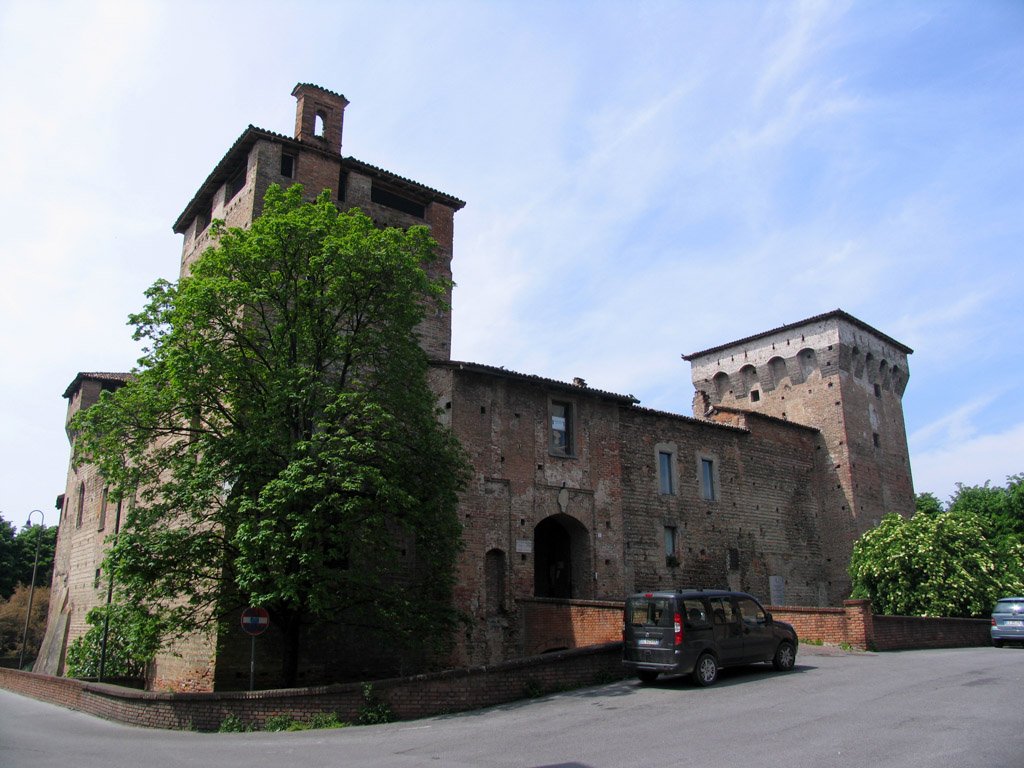
The Rocca Viscontea of Romano di Lombardia is a massive lowland fortress in the Bergamo area: walls over five meters high, four towers, and Ghibelline merlons tell of centuries of borderland between Milan and Venice.
Today it can be explored on guided tours for groups of up to 20 people: visitors climb the towers and the walkways along the walls and, on the piano nobile, step into the Museum of Community Memory.
Please note: the route is not accessible to people with reduced mobility, while small dogs may enter at the discretion of the staff.
The southeast tower is the oldest and houses the late-16th-century chapel with its bell-gable.
The frescoed loggia of Bartolomeo Colleoni is the mark of the condottiero’s passage through the fortress.
In the courtyard, the fresco of the Lion of St Mark stands out, with the vivid colors of the Venetian era.
Museum admission is free, while the guided tour costs €5, free for children up to 6 years.


Events nearby


Copertina itinerario Rocca Viscontea: Medieval Fortress in Romano di Lombardia
Four towers, the loggia of Bartolomeo Colleoni, and the Lion of St Mark: the Rocca Viscontea in Romano di Lombardia, in the province of Bergamo. Guided tours and the Museum of Community Memory.

Good to know


Visconti Fortress: medieval stronghold of Romano di Lombardia

If you’re passing through these parts, the Rocca Viscontea does not go unnoticed: massive, square-cut, with four towers soaring above the rooftops of Romano di Lombardia. Don’t expect a fairy-tale castle, but rather a border fortress grown between the 12th and 18th centuries. Stepping into the courtyard, you can read the centuries on the walls: river pebbles, Visconti bricks, filled-in Ghibelline merlons, Venetian frescoes. The contrast between military function and refined details – the Colleoni loggia, the Lion of Saint Mark – is what struck me most. Then there’s the Museo Memoria della Comunità, which adds a personal and touching note, among relics of the two world wars. In short: a place that tells centuries without heaviness, walking among towers, ramparts and courtyards.

Historical Notes

The history begins with the fortified village, established after 1171. The name ‘Viscontea’ arrives with the Visconti of Milan, who between the 14th and 15th centuries turn it into a defensive bastion: water-filled moats, drawbridge, towers. After 1428, under Venetian rule, it becomes the residence of the Venetian podestà. For a few months, Bartolomeo Colleoni also stays here, making it more elegant with loggias and trefoil windows. In the 18th century, the military function ends, and the fortress later houses judicial offices. Since 1968, restorations have brought the original elements back to light.

  • After 1171: construction of the fortress in the new borough.
  • 14th-15th century: interventions by the Visconti.
  • 1428: passage to Venice, seat of the podestà.
  • 15th century: sojourn and modifications by Bartolomeo Colleoni.
  • 1968: start of modern restorations.

The Four Towers and Colleoni’s Loggia

Each of the four towers has its own personality. In the south-east tower, you can see the frescoed loggia that Bartolomeo Colleoni had opened up: geometric decorations and, beneath it, a raised little doorway called the ‘pontesella del soccorso’, used as an escape route. The north-west tower, commissioned by the Visconti to oversee Bergamo Gate, was for a long time a prison, also during the Second World War. Along the upper part of the walls run sentry walkways with Ghibelline merlons, partially blocked up but still visible. On the east side, the mighty sixteenth-century earthworks show how carefully the defence was thought out in every detail. As you climb, the view opens out over the village and the broad moat, now green. A guided tour helps you read these traces: without a guide, you might walk past centuries of history unaware.

Courtyards, Frescoes, and the Memory Museum

Inside, two courtyards follow one another: the larger Corte Grande and the Corte della Cancelleria Veneta. Old frescoes resurface on the walls, including the Lion of St. Mark, still vivid in colour. Traces of the fortress’s small church also remain, with remains of frescoes and its bell-gable. The piano nobile hosts the state room, with large trefoil-shaped openings. From here you move on to the Community Memory Museum, founded in 1946 to collect relics and opened in 1965 as a museum-shrine. You will see a cross made from a shell casing, uniforms, helmets, bombs, letters, stereoscopic photographs of the Great War, and a complete first-aid kit. The exhibition is still evolving, but the charm is genuine: every object speaks of real lives.

Why visit it

Let me tell you why it’s worth it. First: it’s a real fortress, not a rebuilt palace. The layers from the 12th to the 18th century are still readable, from the brick bridge that replaced the drawbridge to the Ghibelline battlements. Second: you can walk along towers and wall walks, with guided tours organized for groups of up to 20 people. During the tour, anecdotes and legends pop up, like that of Frederick Barbarossa and a secret passage to Dignone. Third: the Community Memory Museum is free and moving, perfect for understanding the 20th century through real artifacts, from weapons to soldiers’ letters. In short, it’s one of those visits that leave a mark without taking a whole day.

When to Go

If I may offer a piece of advice, I would choose a spring or autumn morning, when the soft light glides over the bricks and the green of the moat frames the scene. In summer the courtyard is lovely but the sun beats down; better to arrive early and enjoy the silence before the groups arrive. Even a gray day has its charm: the atmosphere becomes even more medieval and the museum invites you to linger. The important thing is not to rush: the fortress is best appreciated at a leisurely pace, from one tower to the next.

Nearby

If you still have time, just a few steps away is Palazzo Rubini, the 19th-century home of the tenor Giovan Battista Rubini, with frescoed rooms, original furnishings and objects. Here too, entry is only by guided tour, but it is well worth it. To end on a different note, take a stroll across the lawn of the old moat, now open to everyone: from there, the fortress looks even more imposing, and you really get a sense of the water that once surrounded it.

Itineraries nearby


💡 Did You Know…?

Before you leave, look at the lawn surrounding the fortress: it is the ancient moat, now a public park. The most cherished story here is that of Frederick Barbarossa, who, according to legend, escaped through a secret passage heading to the Dignone, leaving a golden carriage hidden in the tunnel. After the discovery of that passage, a dog, a raven, and a dove sent ahead on reconnaissance returned wounded and bloodstained: that is why no one has ever attempted to go through it again. All that remains for you is the delight of telling the tale in front of the walls.