San Vigilio Castle: A Terrace Overlooking Bergamo Alta

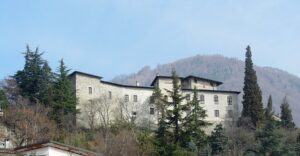
The Castello di San Vigilio stands 496 metres above Bergamo Alta: a star-shaped fortress with four towers, crenellated walls and a lookout stretching from the plain to the Prealps. It can be reached by the San Vigilio funicular, in operation since 1912, or on foot through Porta Sant’Alessandro. Today it is a public park with restaurants, caving tours by reservation and a particularly beautiful view at sunset.
Four towers: Castagneta, Belvedere, Del Ponte and San Vigilio.
360° views over Città Alta, Valbrembo, Almenno and the Prealps.
Underground passages with a countermine tunnel that can be visited with Le Nottole.
Historic funicular and a scenic walk from Porta Sant’Alessandro.


Events nearby


Copertina itinerario San Vigilio Castle: A Terrace Overlooking Bergamo Alta
A fortress 496 metres above Città Alta: four towers, the Nottole underground passages, a funicular dating back to 1912, and views over the Prealps and the Bergamasque plain.

Good to know


Bergamo’s Terrace

The San Vigilio Castle is Bergamo’s natural terrace. It stands up there, on the hill of the same name, at 496 metres, and from up here the city looks like a model. On one side Città Alta with its towers, on the other the plain stretching into the distance, then Monte Bastia, the villages of Valbrembo and Paladina and the Almenno plain. If you turn your gaze, the Prealps come into view. Don’t expect a fairy-tale castle with a drawbridge: here you breathe the air of a military fortress, among gun emplacements and loopholes. And that is exactly its charm. It has a star-shaped plan and four large towers: Castagneta, Belvedere, Del Ponte and San Vigilio. You can reach it on foot or by funicular, and in just a few minutes you truly enter another world.

Historical Background

The origins date back to the past: perhaps there was already a watchtower in Roman times, but the first documented fortification dates to the 6th century. In 889 Arnulf of Carinthia conquered the stronghold, known as the Castle of the Chapel after the small church of Santa Maria Maddalena. In 1166 the Municipal Council of Bergamo decided to build a larger one; the Visconti completed the fortification in 1335 and the Republic of Venice turned it into a permanent garrison from 1428. The Renaissance portal by Mauro Codussi was demolished in 1829 by the Austrians. At the end of the 19th century the Soregaroli family bought the structure and opened a restaurant there. The municipality bought it back in 1957 and opened it to the public in 1962.

  • 6th century – first documented fortifications
  • 889 – Arnulf of Carinthia conquers the Castle of the Chapel
  • 1166 – the municipality decides to enlarge the castle
  • 1335 – the Visconti complete the fortification
  • 1428 – Venetian rule begins
  • 1485-1487 – the four bastions are built
  • 1912 – the funicular is inaugurated
  • 1962 – the castle opens to the public

Four Bastions and the Star-Shaped Plan

The shape is unmistakable: a star-shaped plan with four circular corner bastions—Castagneta, Belvedere, Del Ponte and San Vigilio—built between 1485 and 1487 under the Republic of Venice and linked by a polygonal curtain wall. Inside the towers are casemates for artillery, and above the cannon port is an opening for aiming. The upper square measures 40×70 metres and is surrounded by crenellated walls; below it is the main cistern. In the lower square were the powder magazine and soldiers’ quarters. Between 1585 and 1595 a sloping rampart was added to withstand artillery fire, and the central tower was demolished. The moat completed the defensive system. Today you can stroll among battlements, walkways and embrasures, with panoramic views entering from every opening.

The Underground Passages of Le Nottole

Beneath the castle lies a hidden world. A network of tunnels, secret passages, and escape routes dug to withstand sieges. Defenders opened counter-mine galleries to intercept anyone trying to bring down the walls with explosives. A counter-mine tunnel carved entirely through rock is accessible from the Castagneta tower. It was discovered in the 1970s by the caving group Le Nottole, which still organizes guided tours by reservation today. Legend tells of a secret passage to Fort San Marco; in reality, the covered way, built between 1607 and 1616, was destroyed by the French in 1797. Going down here is a whole different experience from the usual walk around the walls: darkness, rock, and history.

The 1912 Funicular

The San Vigilio funicular is the most convenient way to reach the top. It was inaugurated in 1912, when the area began to fill with villas, and it links the hill to Porta Sant’Alessandro, the 1561 Venetian gate with the lion of Saint Mark. It is 630 metres long and the ride takes less than three minutes. Out of service since 1976, it was restored in 1991, and since then it has been a small ritual for Bergamo locals and for visitors to the city. The cars climb steeply and in an instant Città Alta falls away as the view opens up. From the arrival station, continue on foot for a short climb to the castle. A practical detail: timetables change with the seasons, so it is best to check them before heading up.

Why visit it

Three concrete reasons. First: the view. From 496 metres up you can see Città Alta, the plain, Monte Bastia, the villages of Valbrembo and Paladina, the Almenno plain and the Prealps. Second: the military architecture. The star-shaped plan, the four bastions, the gun embrasures and the arrow slits tell of centuries of sieges, from the Visconti to Venice. Third: admission is free and the castle is a public park with panoramic terraces, open all year round; on the hill there are two restaurants and a boutique hotel housed in the old military building. And then there are the underground tours with Le Nottole, which turn the walk into an adventure. It is not the classic picture-postcard castle, but that is exactly why it stays with you.

When to Go

There’s no wrong season, but the right moment makes all the difference. My advice is sunset: the warm light sets the plain and the Prealps aglow, and Città Alta fills with lights. The early morning hours have their own charm too, with mist rising from the valleys. In autumn the colors are splendid, in spring the hills turn green. In summer the castle stays accessible until evening, so you can go up after dinner; in winter, with clear air, the view reaches farther. If you can, avoid the middle hours of an August day and choose soft light: the panorama and your photos will thank you.

In the Surroundings

After the castle, it is worth extending your gaze and your steps. The Bastia hill (518 m) was fortified by the Visconti in 1373 and offers another fine viewpoint over the hills. Alternatively, a walk along the Venetian Walls of the Upper City, with Porta Sant’Alessandro from 1561 and the Lion of Saint Mark, ideally links the funicular to the historic centre and its alleys. Those who stay on the hill will find the Church of San Vigilio, of ancient origin (8th century), and a few addresses for a tasty stop. And for fans of urban speleology, the Le Nottole visits to the underground areas complete the day in the best possible way.

Itineraries nearby


💡 Did You Know…?

Legend has it that a secret passage once connected the castle to Forte San Marco: in reality, it is a countermine tunnel carved into the rock, discovered in the 1970s by the Le Nottole caving group and accessible from the Castagneta tower. A curious fact: the 1912 funicular was commissioned by the Soregaroli family, who had opened a restaurant here; today two luxury restaurants and a boutique hotel remain on the hill.