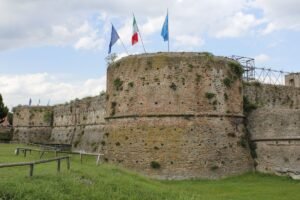
Perched on a spur of red jasper at the confluence of the Ceno and Noveglia rivers, Bardi Castle is one of the best-preserved fortified complexes in the Parma Apennines. From its early medieval origins to the Landi lordship, it offers a journey through the keep, wall walks, princely halls, and six museum sections. The visit lasts about an hour and fifteen minutes; full ticket is €10, reduced €6. Not to be missed: • Walkable wall walks with views over the Ceno Valley • The medieval icehouse and the well in the courtyard • Museum of Valley Civilization and Museum of Wildlife and Poaching • Hall of Princes and the legend of Soleste and Moroello.
Bardi Castle, a jasper fortress between legends and museums
If you come from Parma, the road climbs between hills and woods until Bardi appears like a stone nativity scene: the village clinging to the rock and, above all, the massive outline of the castle. It’s not a glossy postcard fortress. It’s made of thick walls, narrow passages, and stone that time has made even darker. The spur of red jasper on which it rests catches the light at sunset and explains why this spot was fortified early on. Here you can breathe the Middle Ages, but there is also the life of a village that has chosen to tell its own story. Amid the wall walks and museums, you encounter feudal lords, peasants, and the love story of Moroello and Soleste. A visit here becomes a physical journey: you climb, you slip into corridors, you look at the valley from a privileged vantage point. And you bring home a piece of the Apennines.
Historical Notes
The earliest traces date back to the early 9th century, when the castle was a refuge from Hungarian raids. In 898, it was sold to the Bishop of Piacenza, who made it a stronghold. Centuries of rule by the Counts of Bardi followed, then in 1257 Ubertino Landi bought it and rebuilt it after its destruction in 1251. From then on, the fortress was the heart of the Landi state, with the right to mint coinage and a princely court. In the 1500s, Federico Landi turned it into a stately residence with a library, armory, and picture gallery. With the end of the Landi in 1682, the decline began: it passed to the Farnese and then to the Bourbons. In the 1800s, it became a military prison and municipal seat; after World War II, following a bombing, restoration work began and gave it back to the public.
- 898 – sale to Bishop Everardo
- 1257 – Ubertino Landi acquires the fortress
- 1551 – the Landi obtain the title and minting right
- 1682 – extinction of the Landi
- 19th century – prison and municipal seat
- 1960s – start of restoration
Rampart Walks and Stairs That Turn Right
Pass under the ravelin, cross the guardroom, and step into the courtyards. The castle is a vertical maze: the Parade Ground, the Well Courtyard, and the Courtyard of Honour with its 17th-century staircase. The sloping walls follow the jasper spur and support the wall walk, one of the best places to look out over the Ceno valley and the village. Almost everything is exposed stone. The keep, with its corbels, retains an ancient, austere air. Then there are the service areas: the icehouse, stables carved into the rock, granaries, prisons, and the torture chamber. The winding staircases all turn right—a defensive choice that now becomes a curious detail to recount. And the route weaves through 31 points of interest, never monotonous.
Six museums inside the castle
Here you don’t visit a single museum, but a network of exhibitions: the Museum of Valley Life, which reconstructs trades and homes from the late 19th century, the Archaeological Museum of the Ceno Valley, the Museum of Wildlife and Poaching, the exhibition ‘Postcards from Valceno’, the Ferrarini-Nicoli Collection on arts and crafts, and the display of arms and costumes. In addition, there are rooms dedicated to Captain Pietro Cella, the first gold medal of the Alpini Corps, and the Coordination Centre for Italian Masks of Parma. Every space recounts a slice of valley life: from farmhouse rooms to soldiers’ weapons, from masks to Alpine mementos. It’s an eclectic ensemble, but that’s exactly what makes it suitable for all: everyone finds their shelf, their story, their corner.
The Legend of Moroello and Soleste
The charm of the castle is intertwined with a tragic story. It is said that the knight Moroello, returning from war, wanted to mock the enemy by wearing their insignia. His beloved Soleste, from the castle, saw them and believed that the adversaries were arriving: she thought Moroello was dead and threw herself from the tower. When he arrived and understood what had happened, he took his own life. Since then, they say, his spirit wanders among the walkways. The legend is so deeply felt that on the ground floor of the keep there is a dedicated exhibition. In the 1990s, alleged photos of ghosts and thermal images sparked discussions; no evidence convinced everyone, but the atmosphere has remained. In the evening, when the groups have left, it is easy to feel a chill.
Why Visit It
The Bardi Castle is worth the trip for at least three reasons. The first is the landscape: it is hard to find a fortress so connected to the rock and the valley, with the Ceno and Noveglia streams meeting below its walls. The second is the variety of things to see: medieval architecture, ethnographic museums, archaeology, collections and legends coexist within the same complex. The third is the care put into its management: the castle is alive, with a program of events that makes it different each season. And then there’s the practical detail: it is one of those places that can be visited even when the weather is not perfect, because the route winds through halls, towers and covered walkways. In an hour and a half, you get a complete overview.
When to go
The best time? Late afternoon, when the low sun lights up the jasper and the castle casts its long shadow over the valley. In autumn the light is golden and the Ceno mists add mystery, perfect for the ghost story. In winter the offer is reduced, but weekend openings have a more intimate feel; in summer, however, the pace expands and you can easily arrive even late in the morning. The castle often follows a weekend calendar out of season and daily openings in the warm months, so don’t take the opening hours for granted: check the website before you leave. The fortress looks good even under a grey sky, but the colors of sunset stay in your heart.
In the Surroundings
After the visit, take some time to explore the village of Bardi and its narrow streets: walking beneath the fortress rewards you with glimpses that no guidebook can capture. If you enjoy walking, along the paths that trace the Via degli Abati and the variants of the Via Francigena, you can breathe the same silence that must have accompanied pilgrims. The area is part of the Castles of the Duchy circuit: for those who never get enough, the lands of Parma and Piacenza offer many other fortresses to discover, each with a different atmosphere but the same borderland history. One more idea? Before you leave, find a spot where you can see the castle in full, with the village at its feet: that alone is a reason to come back.