The Victory Monument in Bolzano: BZ ’18–’45 Exhibition

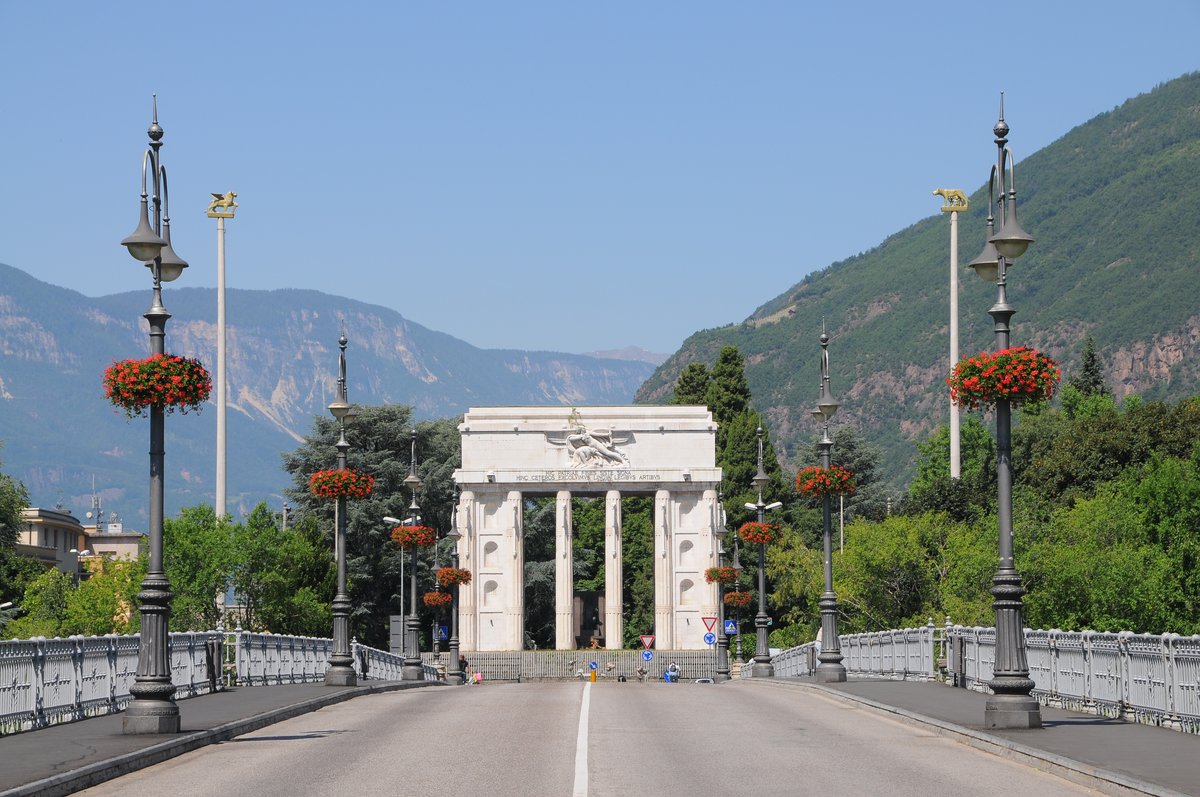
The Victory Monument in Bolzano is a marble arch by Marcello Piacentini, inaugurated on July 12, 1928. Since 2014 it has housed the BZ ’18–’45: One Monument, One City, Two Dictatorships route, with underground rooms, videos, and documents. It is located in Piazza della Vittoria, near the Talvera and the historic center.
Free admission and a barrier-free route.
13 rooms covering 700 sq m plus the chapel frescoed by Guido Cadorin.
– Free guided tours for groups and schools, by reservation.
– Open Tuesday to Sunday, closed Monday.


Events nearby

Copertina itinerario The Victory Monument in Bolzano: BZ '18–'45 Exhibition
The Siegesdenkmal in Piazza della Vittoria in Bolzano, designed by Marcello Piacentini in 1926–1928, houses the BZ ’18–’45 route: free admission, guided tours, and barrier-free access.

Good to know


Introduction: A Marble Arch That Doesn’t Go Unnoticed

Piazza della Vittoria in Bolzano has a problem of scale: the Monument to Victory (Siegesdenkmal) takes up the space and dominates it. It is an imposing marble triumphal arch—almost a temple, with tall columns and fasces—designed by Marcello Piacentini and built between 1926 and 1928. From the outside it appears majestic, a little out of scale with the city around it; up close, the pale stone, the inscriptions and the sculptures are striking. For a long time it was an uncomfortable place, a symbol of Fascism and of the Italianized border, and today that is precisely what makes it interesting: a monument that cannot be dismissed with a quick photo. You stop, read, feel a little uneasy—and that’s fine. Because it is also the starting point of the exhibition BZ ’18–’45.

Historical background: from Kaiserjäger to Siegesdenkmal

The monument stands where, in the Austro-Hungarian era, there was the Kaiserjäger Monument, left unfinished and removed after the Italian occupation of Alto Adige on 3 November 1918. The first stone was laid on 12 July 1926 in the presence of Victor Emmanuel III; the inauguration came on 12 July 1928, the anniversary of Cesare Battisti’s death. The Latin inscription contained the word barbaros, later replaced with ceteros. In 1978 a bomb attack damaged Adolfo Wildt’s herms; in 2001 the square was renamed Piazza della Pace, but a referendum the following year restored the original name.

  • 1918 – removal of the Kaiserjäger Monument
  • 12 July 1926 – laying of the first stone
  • 12 July 1928 – inauguration
  • 1978 – bomb attack
  • 2001-2002 – Piazza della Pace and return to Piazza della Vittoria
  • 2005 – plaques in four languages
  • 2014 – opening of the BZ ’18–’45 route
  • 2019 – collapse of a slab

Inside the monument: what you see in the BZ ’18–’45 exhibition

Here lies the surprise: beneath the monument you go down and enter a route of 13 underground rooms spread over about 700 square metres, inaugurated in July 2014. The exhibition is divided into two areas: the outer perimeter ‘History and Territory’, with videos, photos, posters and documents from 1918 to 1945, and the inner perimeter ‘The Monument and Its History’. Four corner rooms raise questions about the very concept of a monument, with M-shaped furniture that seems to deform. Outside, a black LED ring encircles a central column bearing the exhibition title in three languages: a contemporary gesture that desacralizes the fascist work. The display uses steel panels, blurred blow-ups and asymmetrical glass. There is also a frescoed chapel and a virtual reality experience.

The signatures on the marble: the monument’s artists

Behind the monolithic image are many hands. The design is by Marcello Piacentini (Rome 1881–1960), one of the central figures of early twentieth-century Italian architecture. On the east pediment is the Vittoria sagittaria by Arturo Dazzi; the west pediment houses three medallions by Pietro Canonica with the New Italy, Air, and Fire. The eight heads of helmeted soldiers and animals on the columns are by Giovanni Prini. Inside, flanking the altar with the Christ the Redeemer by Libero Andreotti, are the busts of Cesare Battisti, Fabio Filzi, and Damiano Chiesa, by Adolfo Wildt. The crypt is frescoed by Guido Cadorin. Knowing who made what changes the way you see it: it is not an anonymous block but a catalogue of different names and styles.

Why visit it (really)

First, a very practical reason: admission is free and the route is fully accessible, with an accessible entrance for disabled visitors on Corso Libertà. Second: this isn’t just a place for celebration—it reflects on two dictatorships, fascist and National Socialist, and on how Bolzano coexisted with this legacy. It’s a museum that presents a problem, not a medal. Third: its location, between the old town and the Talvera Meadows, makes it an easy stop to fit into a walk. One more detail for the curious: for those who cannot or prefer not to approach the outdoor sections, there is a virtual reality experience with headsets available by reservation. In short, a place that surprises more than you’d expect from a marble arch.

When to go

The square is exposed, and the pale marble changes dramatically with the light. In the early morning, when Piazza della Vittoria is still quiet and there are few passersby, is perhaps the best time: the low sun makes the inscriptions and sculptures stand out. The late afternoon also has its charm, with softer light on the columns. If you can choose, autumn is ideal: the air is clear, the nearby Talvera Meadows turn colour, and the visit is never as stifling as in high summer. Bear in mind a minor but useful detail: the exhibition route closes on Mondays, so avoid that day if you want to go inside rather than just admire the exterior. For up-to-date opening hours, it’s best to check the official website.

Nearby: What to Pair with the Visit

Once you leave the monument, the best way to continue is on foot. Just a few steps away are the Prati del Talvera, the large green lung along the stream, perfect for a walk or a break on the grass. It’s worth heading to Piazza del Tribunale, where you’ll find the monumental bas-relief by Hans Piffrader: since 2017 it has borne Hannah Arendt’s quote “No one has the right to obey”, which resonates well with the monument’s route. And then there’s the old town, with its streets, arcades and market: a pleasant contrast to the monumental scale of the square. Putting these stops together helps you understand Bolzano, not just its marble arch.

Itineraries nearby


💡 Did You Know…?

In 1978, a bomb attack damaged Wildt’s herms; in 2001, the square was renamed Piazza della Pace, but a referendum in 2002 restored the name Piazza della Vittoria. Since 2005, four plaques in Italian, German, Ladin, and English have provided context for the monument. After a slab collapsed in 2019, a VR experience allows visitors to observe it up close.