
🧭 What to Expect
- Ideal for a cultural weekend of art and history
- Highlights: Teatro dell’Aquila, Civic Art Gallery, Roman Theatre
- Recommended for archaeology enthusiasts and families
- Best time: spring and autumn
Events nearby


Città di Fermo, capital of the province of the same name in the Marche region, is a destination that surprises with its artistic and historical richness. Strolling through the historic center, you’ll come across noble palaces, elegant squares, and ancient theaters. The Teatro dell’Aquila, one of the oldest in Italy, amazes with its acoustics and frescoes. The Civic Art Gallery houses works by great masters such as Crivelli and Gentileschi, while the Roman Theatre from the Augustan era tells the story of the city’s Roman roots. For nature lovers, the ‘Tommaso Salvadori’ Ornithological Museum boasts a unique collection of Italian birds. The Torre Matteucci offers a breathtaking panoramic view, and the Diocesan Museum preserves precious sacred furnishings. Fermo is easily reachable and lends itself to a day trip or a weekend visit. Don’t miss the chance to taste local specialties such as fossa cheese and Rosso Piceno wine. An itinerary that combines art, history, and tradition, perfect for an authentic trip in the Marche region.
Overview
- Teatro dell’Aquila: An 18th-Century Gem to Discover
- Pinacoteca Civica: Masterpieces and History in the Heart of Fermo
- The Roman Theatre of Fermo: A Hidden Treasure
- Matteucci Tower: The Tower of the Commander and the Princess
- Museo Diocesano: Sacred Art and History in Fermo
- Tommaso Salvadori Ornithological Museum
Itineraries nearby

Teatro dell’Aquila: An 18th-Century Gem to Discover
- Go to the page: Fermo’s Aquila Theatre: Perfect Acoustics and One of the Largest Stages in the Marche Region
- Via Giuseppe Mazzini, Fermo (FM)
- Open in Google Maps
- View on Google Images
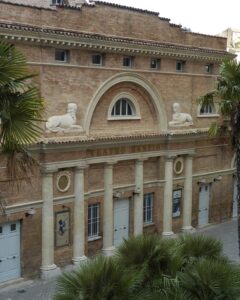
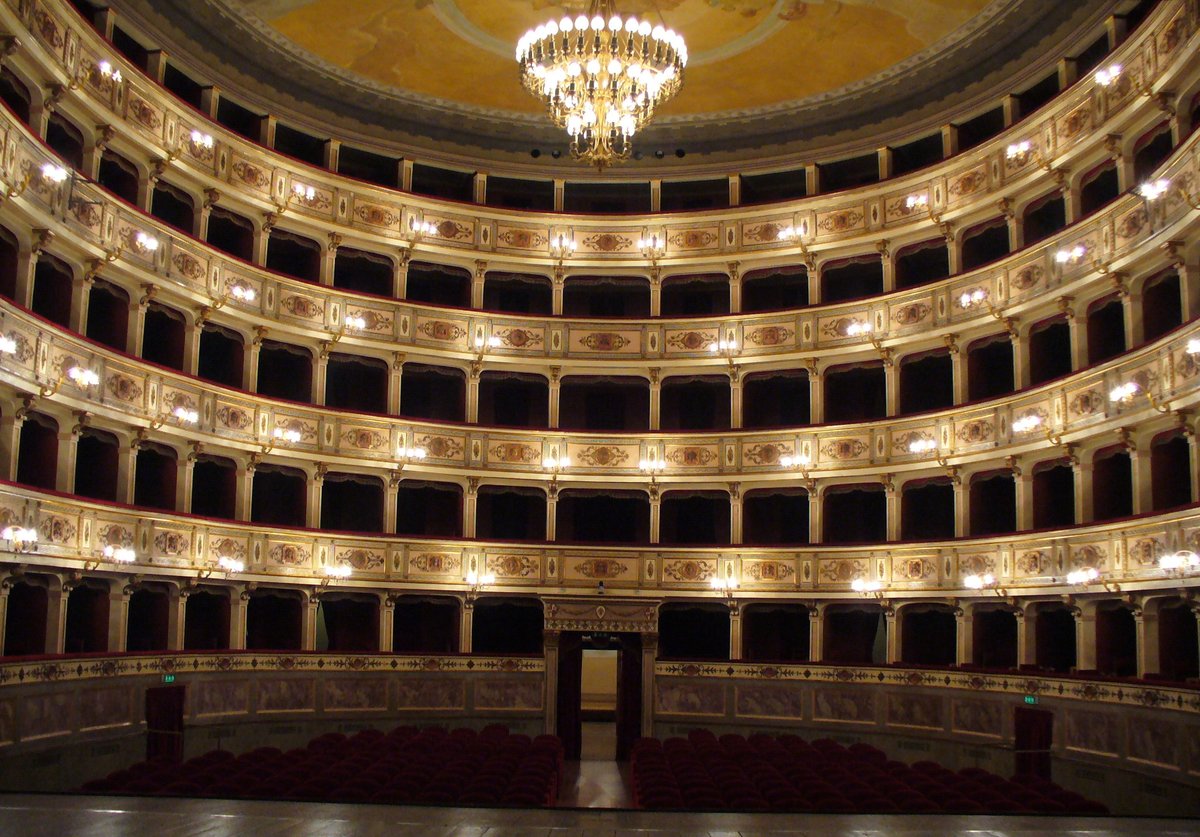 If you’re passing through Fermo, you can’t miss the Teatro dell’Aquila. It’s one of the most impressive historic theaters in the Marche, and as soon as you step inside you’ll understand why. Designed by architect Cosimo Morelli, it opened on September 26, 1790, and has been the cultural heart of the city ever since. The horseshoe-shaped auditorium boasts 124 boxes spread over five tiers, seating about 1,000 people. The stage covers 350 square meters and is slightly sloped for optimal viewing. The acoustics? Among the best in Italy, say enthusiasts.
As you climb the stairs, you’ll immediately notice the ceiling frescoed by Luigi Cochetti: it depicts the Olympian gods listening to Apollo’s song, with the Three Graces and the Hours of the Night dancing. At the center hangs a 56-arm chandelier in gilded iron and wooden leaves, bought in Paris after the 1826 fire – yes, because the theater has had a troubled history: a fire severely damaged it, then it closed in 1984, and finally restored and reopened in 1997. Today it’s more alive than ever, with a season running from October to June featuring plays, opera, and concerts.
To visit, you need to book a guided tour (it costs only €4 for the special ticket, or €10 for the Fermo museum circuit, valid for one year). The tour takes you from the foyer to the stalls, and if there’s a set, you’ll peek from the second-tier boxes. It’s wheelchair accessible, and if you can’t come, there’s also an online virtual tour. In short, a plunge into the 18th century that you’ll never tire of admiring.
Pinacoteca Civica: Masterpieces and History in the Heart of Fermo
- Go to the page: Fermo Civic Art Gallery: Masterpieces from the 14th to the 18th Century in the Palazzo dei Priori
- Piazza del Popolo, Fermo (FM)
- Open in Google Maps
- View on Google Images
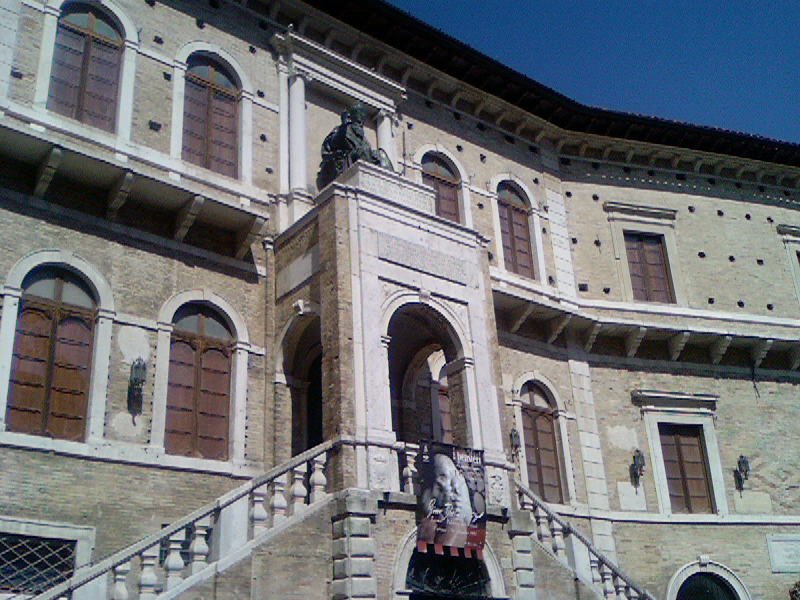 The Pinacoteca Civica in Fermo is one of those museums that surprises you. Located on the second floor of the Palazzo dei Priori, in Piazza del Popolo, it houses works from the 14th to the 19th century. The route winds through five rooms, each with its own character: the Gothic Art Room, with the polyptych by Andrea da Bologna (1369) and the Stories of Saint Lucy by Jacobello del Fiore, and the Seventeenth-Century Room, where the Adoration of the Shepherds by Peter Paul Rubens stands out – his only work in the Marche. Also not to be missed are frescoes by Andrea Boscoli and canvases by Giovanni Lanfranco.
But the true gem is the Map Room, the ancient core of the Spezioli Library: a wood-paneled room with a coffered ceiling and a huge globe designed by cosmographer Amanzio Moroncelli in 1713. Here you breathe history among thousands of 16th-century volumes.
Don’t miss the statue of the Margutto, a warrior in oak wood used for the ring joust, recently restored.
The gallery reopened after the 2016 earthquake and is now more accessible than ever. Hours: Tuesday-Sunday 10:30 AM-6:30 PM. Full ticket: €9 (museum circuit). A tip? On the first Sunday of the month, admission is free.
The Roman Theatre of Fermo: A Hidden Treasure
- Via del Teatro Antico, Fermo (FM)
- Open in Google Maps
- View on Google Images
 The Roman Theatre of Fermo is one of those places that makes you think about how history can sometimes be hidden right beneath our feet. Built probably in the 1st century BC, just before Augustus’s urban reforms, it stood on Colle del Girfalco, the highest point of the city. With a diameter of about 37 meters and an estimated capacity of over 2,000 spectators, it must have been an imposing symbol of Romanitas. Today, however, only fragments remain, because the theatre has never been fully excavated or restored. Much of its structure has been incorporated into later buildings, such as Palazzo Matteucci (now home to the Cassa di Risparmio bank) and the Collegio degli Artigianelli. If you stroll along Via del Teatro Antico, which starts from the cathedral parvis, you can still see a stretch of the semicircular wall of the corridor that ran beneath the cavea, about 3.5 meters wide. On the other side, a low wall built on the base of the other wall. Peering over, you’ll notice that the courtyard of the Collegio degli Artigianelli still preserves its original semicircular shape. In the basements of some palaces, remains of niches and Roman walls are hidden, like those discovered in 1934 under the Cassa di Risparmio. Two columns of limestone and pink scaglia from the Apennines, dating to the 3rd century AD, are visible in the courtyard of Palazzo Vitali Rosati on Corso Cefalonia. In short, the Roman Theatre of Fermo is not a picture-postcard attraction, but an adventure for those who love to seek out signs of the past among the folds of the modern city.
Matteucci Tower: The Tower of the Commander and the Princess
- Corso Cavour, Fermo (FM)
- Open in Google Maps
- View on Google Images
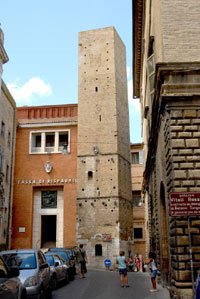 In the heart of Fermo, right at the intersection of Corso Cefalonia and the small square of the Carmine church, stands Matteucci Tower, the only medieval civic tower in the city still standing. At 25 meters tall, with a base of 5×4 meters in Istrian stone blocks, this structure tells centuries of history. Built between the 13th and 14th centuries, it passed to the Matteucci family in the 1500s, from whom it takes its name. The most famous legend? That of the commander Saporoso Matteucci, who in 1542 captured an Ottoman princess (perhaps the daughter of Suleiman the Magnificent) during a naval battle. He brought her to Fermo and hosted her in the tower, where an impossible love blossomed. He freed her, but the story remains etched in its walls. Over the centuries, the tower also served as a war memorial (a plaque commemorates this) and, after recent restoration, it is open to visitors on special occasions like “Fermo Attivo.” Climbing the wooden staircase – preserved during the works – you reach the top, where the view stretches from the sea to the mountains, passing over the hills of the Fermano area. It is not open every day, but if you happen to be there during one of the event days, don’t miss the chance: it’s an authentic dive into medieval Fermo.
Museo Diocesano: Sacred Art and History in Fermo
- Via del Teatro Antico, Fermo (FM)
- http://www.museodiocesanofermo.it/
- Open in Google Maps
- View on Google Images
 Just a stone’s throw from the Cathedral, in the premises of the ancient Confraternity of the Suffrage, the Diocesan Museum of Fermo is one of those surprises that make you fall in love with the city. Opened in 2004 at the behest of Archbishop Cleto Bellucci, it houses centuries of sacred art from the Early Christian to the 20th century. Stepping inside, the atmosphere is intimate and solemn, perfect for being amazed by the collection’s highlights. The Missal de Firmonibus, an illuminated manuscript from 1436 by Giovanni di Ugolino da Milano, is a true spectacle: its pages, with the famous ‘Cavalcata’ of the Assumption, seem to come to life. But my favorite is the Casula of St. Thomas Becket, an Arabic fabric from 1116, donated by the saint’s mother to the Church of Fermo – a rare example of textile art that transports you to another era. In the Treasury Room, also stand out the Stauroteca of Pius III and the monumental bronze ciborium by the Lombardi-Solari brothers. Then there are the silver items, with the pontifical set by Valadier, and the art gallery, where works by Crivelli, Barocci, and Hayez converse with each other. A single ticket costs €4, but if you have time, the museum circuit at €10 is worth it. The museum is open Saturday and Sunday from 10 am to 5 pm, with last entry at 4:30 pm. Don’t expect fixed weekday hours: it’s better to book. A tip? Stop to observe the details of the vestments: each embroidery tells a story of faith and art.
Tommaso Salvadori Ornithological Museum
- Viale Trento 29, Fermo (FM)
- Open in Google Maps
- View on Google Images
 If you think a museum of stuffed birds might be dusty and dull, prepare to be surprised. The Tommaso Salvadori Ornithological Museum, now housed in Palazzo Paccaroni (Corso Cavour 68), is a constant delight. Inside, there are about 500 specimens, many collected and prepared personally by Salvadori, the foremost Italian ornithologist of the 19th and 20th centuries. Among them, extremely rare species like the Osprey, the Cinereous Vulture, the Bearded Vulture, and the Eurasian Eagle-Owl. There are also some specimens of species now extinct, a real heart-stopper. Salvadori wasn’t just a scientist; he was a man who loved details, studying the poses of his birds to make them look alive, almost in flight. The rooms, with their frescoed ceilings, tell a story of boundless passion. The collection arrived in Fermo in 1930 thanks to his great-granddaughter Gladys, and survived the 2016 earthquake, which forced the move from Villa Vitali to this new location. Today, it is part of the Scientific Hub together with the Silvio Zavatti Polar Museum. Opening hours: Saturday and Sunday 3–7 PM, other days by appointment. Single ticket: €4, or €9 for the museum circuit. Info and bookings: 0734 217140. A tip? Don’t miss the room with the Bearded Vulture: it looks you straight in the eye.