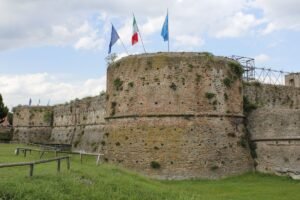
Canossa Castle: Medieval Ruins and the Humiliation of Henry IV in 1077

Perched on a sandstone spur at 576 meters, Canossa Castle is a historic site where you can breathe in the atmosphere of the Middle Ages. Founded in 940 AD, it became famous in 1077 for the humiliation of Henry IV before Pope Gregory VII during the Investiture Controversy. Today, its evocative ruins offer a 360-degree panoramic view over the Reggiano hills and are part of the Parco Regionale dell’Alto Appennino Reggiano.

  • Historical Episode of 1077: site of Henry IV’s humiliation, waiting three days and three nights in the snow.
  • Layered Architecture: three concentric defensive walls, the rock-hewn Chapel of Sant’Apollonio with medieval frescoes.
  • Breathtaking Panorama: 360-degree view over the Reggiano hills, the Apennines, and on clear days, as far as the Alps.
  • Nature Trails: paths starting from the ruins within the Parco Regionale dell’Alto Appennino Reggiano.


Events nearby


Copertina itinerario Canossa Castle: Medieval Ruins and the Humiliation of Henry IV in 1077
Visit the ruins of Canossa Castle, where in 1077 Emperor Henry IV waited three days in the snow for papal forgiveness. Breathtaking views over the Reggiano hills, layered architecture, and the rock-hewn Chapel of Sant’Apollonio.

Good to know


Introduction

Arriving at the Castle of Canossa is like flipping through a living history book. Perched on a sandstone spur at 576 meters above sea level, it dominates the Reggio Emilia hills with an air of majestic decay that immediately strikes you. These are not just ruins: here you breathe the echo of the famous humiliation of Henry IV in 1077, when the emperor waited three days and three nights in the snow to obtain papal forgiveness. The view stretches from the Apennines to the Po Valley, offering one of the most spectacular vantage points in Emilia-Romagna. The sensation is of standing on a natural stage where a crucial page of European medieval history was written.

Historical Overview

The castle’s history begins in 940 AD with Atto Adalberto, but its moment of glory came with Countess Matilda of Canossa, who made it the center of her power. It was here in January 1077 that the famous humiliation of Henry IV before Pope Gregory VII took place, a key episode in the Investiture Controversy. The castle was gradually abandoned after the 15th century, and today mainly the stone foundations remain, allowing visitors to trace the original layout. Archaeological excavations have uncovered artifacts that tell the story of daily life in the Early Middle Ages.

  • 940 AD: Foundation by Atto Adalberto
  • 1077: Humiliation of Henry IV before Pope Gregory VII
  • 12th-15th century: Period of greatest splendor under the Canossa family
  • 15th century: Beginning of decline and gradual abandonment
  • 1878: Declared a national monument

Layered Architecture

Walking among the ruins of Canossa Castle means discovering a unique architectural stratification. Three concentric defensive walls protecting the central core, where the count’s palace once stood, are clearly distinguishable. Particularly fascinating is the Chapel of Sant’Apollonio, built directly into the rock, which preserves traces of medieval frescoes. The remains of the towers, especially the eastern one, showcase construction techniques using local sandstone. The absence of modern reconstructions allows visitors to appreciate the site’s authenticity, where every stone tells centuries of Emilian history.

The Landscape as Protagonist

The castle’s location is no coincidence: it controlled the communication routes between the Po Valley and Tuscany via the Passo delle Radici. Today, this means the panorama is breathtaking in 360 degrees, with views of the clay badlands of the Reggiano Apennines and, on clear days, all the way to the Alps. The ridge on which it stands is characterized by unique sandstone geological formations, creating a spectacular contrast with the surrounding vegetation. The site is an integral part of the Alto Appennino Reggiano Regional Park, offering nature trails that start directly from the ruins.

Why Visit

Three concrete reasons make this visit unmissable: first, the opportunity to experience firsthand a symbolic site of the Italian Middle Ages, where the relationship between temporal and spiritual power was decided. Second, the chance to combine history and nature in a single experience, with trails leading from the castle into the surrounding hills. Third, the proximity to other Matildic attractions such as Rossena Castle and the Pieve di Santa Maria, allowing you to build a complete thematic itinerary around the figure of Matilda of Canossa.

When to Visit

The most evocative time for a visit is in the early morning hours, when the low-angled light accentuates the textures of the sandstone and the mists from the plain create an almost surreal atmosphere. In late spring, the blooming broom on the rocky slopes adds splashes of color to the landscape, while in autumn the gullies take on particularly photogenic golden hues. Avoid the midday hours on summer days, when the blazing sun makes exploring the exposed ruins less enjoyable.

In the Surroundings

Complete your experience with a visit to Rossena Castle, just a few kilometers away, perfectly preserved and still inhabited, offering a direct contrast to the ruins of Canossa. For food and wine enthusiasts, don’t miss the opportunity to taste Reggiano Lambrusco in the local wineries of Canossa and Quattro Castella, where the winemaking tradition has its roots in the Matildic era.

Itineraries nearby


💡 Did You Know…?

Legend has it that Matilda of Canossa, the powerful countess who ruled these territories, used to hide treasures in the castle dungeons. Even today, during maintenance work, medieval coins and artifacts occasionally emerge. Locals say that on full moon nights you can hear the laments of Henry IV waiting for papal forgiveness.