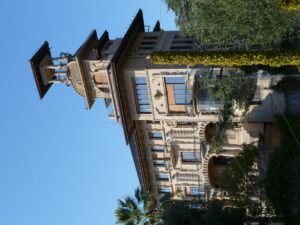
Genoa’s Doge’s Palace, founded in 1251 as the Doge’s residence, is now a vibrant cultural center hosting international exhibitions and events. Located in Piazza De Ferrari, it blends centuries of history with contemporary art in a building that ranges from medieval to Baroque style.
- Temporary international exhibitions in the Hall of the Great Council
- Main Courtyard with Renaissance loggia and ceremonial staircase
- Frescoed halls recounting the history of Genoese governance
- Historic secret passage connecting to the Royal Palace
Introduction
As soon as you arrive in Piazza De Ferrari, the Palazzo Ducale immediately catches your eye. It’s not just a palace; it’s the beating heart of Genoa, a stone giant that tells centuries of power and now vibrates with cultural life. Its facade, with that mix of styles ranging from medieval to baroque, almost looks like an open history book. Entering here isn’t like visiting a static museum: the atmosphere is that of a living place, where doges once decided the fate of the Republic and today you stroll among contemporary art exhibitions. I like to think that, while walking through its courtyards, I’m treading the same stones as admirals and merchants. It’s a place that makes you feel small, yet also part of something grand.
Historical Overview
Its history is a tapestry of power and transformation. Originally built as the town hall in 1251, it later became the seat of the Doge and the government of the Republic of Genoa. Imagine: here, the fate of one of the most powerful maritime republics was decided. In the 16th and 17th centuries, architects like Andrea Ceresola remodeled it, giving rise to the majestic facade on Piazza De Ferrari that we see today. Then, with the decline of the Republic, the palace took on different roles: it even served as a courthouse. Its true rebirth is recent, with the major restorations in the 1990s that returned it to the city as a cultural hub. Today, it hosts international exhibitions in the
Hall of the Great Council, where the patricians once gathered. It is a continuous dialogue between past and present.
- 1251: Founded as the town hall.
- 1339: Becomes the seat of the Doge and the government.
- 16th-17th centuries: Renovations and expansions in Mannerist and Baroque styles.
- Late 1700s: Loses its governmental function with the end of the Republic.
- 1992: Start of the major restorations for Columbus.
- Today: Multipurpose cultural center.
The Two Souls of the Palace
What fascinates me most is how this place manages to hold together two such different souls. On one hand, there is the memory of power. Just look up in the Doge’s Chapel, with its gilded stuccoes, or imagine the secret meetings in the Council halls. On the other, there is a vibrant contemporary energy. Its rooms, like the monumental Hall of the Great Council, now host modern art exhibitions and installations that sometimes create a surprising contrast with the ancient walls. It’s not uncommon to find, next to a 17th-century fresco, a work by a living artist. It’s this mix that makes it unique: not a relic of the past, but a container that dialogues with the present. The internal courtyards, like the Main Courtyard, are spaces of suspension, where the city’s noise fades away.
Beyond the Exhibitions: Hidden Corners
Everyone goes to the major exhibitions, and rightly so. But if you have a little time, lose yourself in the less-traveled spaces. The Loggiato di levante, for example, offers a unique view of the square, slightly off the beaten path. Or, look for the details: the frescoed vaults of some minor halls, the monumental fireplaces, the spiral staircases that seem to lead who knows where. One thing few know is that part of the complex still houses offices and institutions. This gives it an atmosphere that’s not just museum-like, but lived-in. I like to think that, while I’m admiring a painting, someone in an office next door is working. It’s a palace that breathes. Even the ticket office itself is in a historic space, not an anonymous counter.
Why Visit It
First, because it’s Genoa’s ground zero. You understand the city starting from here, from its history of power and commerce. Second, for the cultural offerings: the exhibitions are always high-quality and change frequently, so there’s always a good reason to return. Third, for the architecture itself: it’s a journey through centuries of styles, from medieval to neoclassical, all in one majestic building. And then, let’s face it, it’s a perfect refuge when it’s raining or too hot outside: you can comfortably explore indoors, surrounded by art and history.
When to go
I would recommend avoiding weekend peak hours when the square is extremely crowded. Try a weekday afternoon, perhaps around 4:00 PM. The light filtering through the windows of the upper halls is beautiful, and there’s less hustle and bustle. In winter, when Genoa is gray, its heated and illuminated interiors are an oasis of beauty. In summer, on the other hand, the internal courtyards offer a pleasant coolness compared to the stifling heat of the alleys. If you can, time your visit to coincide with the opening of a major exhibition: the atmosphere is electric.
In the Surroundings
Once you leave the Palace, you’re already in the historic center. A must-see is the Cathedral of San Lorenzo, just a stone’s throw away, with its striking black and white striped facade and the Treasury Museum. For a thematic experience on Genoa’s power and wealth, head to the Palazzi dei Rolli on Via Garibaldi (now Strada Nuova), a UNESCO World Heritage site. These are the opulent residences of aristocratic families that, in turn, hosted illustrious visitors of the Republic. Today, many are museums, such as Palazzo Rosso or Palazzo Bianco. It’s the perfect complement to understand where those who governed from the Ducal Palace lived.