
The Scoglietto Lighthouse is a neo-Gothic jewel perched on an islet facing Portoferraio on the Island of Elba. Built in 1910 and rebuilt after World War II, it’s now automated and solar-powered. The surrounding area is a biological protection zone, perfect for diving and snorkeling. Here’s what not to miss:
Events nearby
10/09/2026 - 04/01/2027

03/06/2026 - 10/06/2026
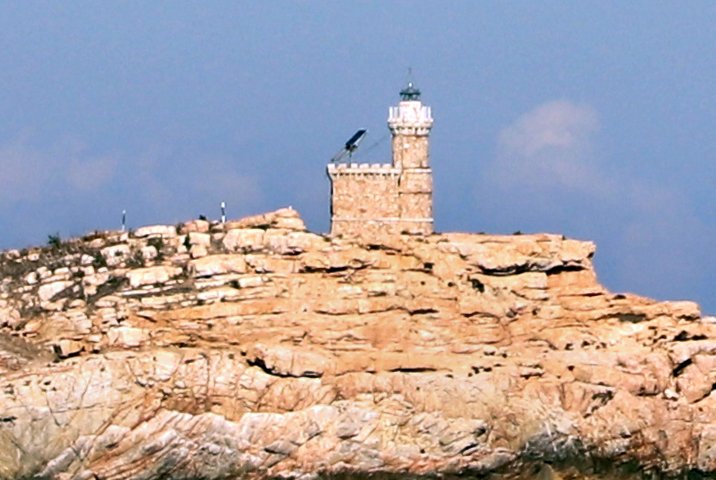
Built in 1910 and rebuilt after the war, the Scoglietto Lighthouse dominates the namesake islet in Portoferraio. Today, it’s a draw for sea lovers thanks to the protected marine area where you can snorkel among groupers and seagrass.
- Via del Falcone, Livorno (LI)
- Open in Google Maps
- View on Google Images Faro dello Scoglietto a Livorno
Good to know
Introduction
On the tiny islet of Scoglietto, facing Portoferraio, stands a lighthouse that seems to have emerged from a fairy tale. Built in 1910, its circular neo-Gothic tower and battlements dominate the crystal-clear waters. Today it’s automated, but its presence turns the area into a magical spot for sea lovers. Surrounding it, the protected marine area teems with life: groupers, sea breams, and Posidonia seagrass. A corner of Elba where history and nature blend, perfect for a day of snorkeling in one of the richest seabeds in the Mediterranean.
Historical Background
The Scoglietto Lighthouse was built in 1910 by the Italian Navy to illuminate the islet at night. Destroyed during World War II, it was rebuilt in 1945, acquiring its current appearance. The circular stone tower, with pointed arch windows and battlements, is Neo-Gothic in style. Once staffed by keepers, it is now fully automated and powered by photovoltaic energy. Its light, two white flashes every 6 seconds, is visible up to 5 nautical miles.
- 1910: construction of the lighthouse
- 1945: post-war reconstruction
- 1971: establishment of the biological protection zone
- Today: automated lighthouse, protected area for snorkeling
Snorkeling in the Protected Area
The waters around Scoglietto are one of the best snorkeling spots in Tuscany. Since 1971, it has been a biological protection area with a total ban on fishing. Here you’ll find giant groupers unafraid of divers, schools of corvina and barracuda, and meadows of posidonia. Two main routes: the Franata, a sloping seabed suitable for beginners, and the Grottoni, for experts, with caves rich in sponges and crustaceans. The water is clear, with almost no current. An experience that makes you feel like you’re in a natural aquarium.
Lighthouse Architecture
The lighthouse is an example of neo-Gothic maritime architecture. The circular tower, 8 meters high, rests on a stone battered base. Attached is a quadrangular building that once housed the keepers. Doors and windows have pointed arches, while the upper part is decorated with projecting battlements. At the top, the circular metal lantern is flanked by solar panels. Everything is in exposed stone, with a rustic charm that evokes the old manned lighthouses. Today, the building is disused, but the structure is well preserved.
Why visit it
First reason: snorkeling. The protected area is unique on Elba for biodiversity: groupers, moray eels, lobsters, and even eagle rays. Second: the lighthouse is a perfect photo set, with the tower emerging from the rocky islet. Third: history. Knowing that this lighthouse has guided sailors for over a century and survived the war adds charm. Plus, it’s very easy to reach: just a swim from Ghiaie beach or a short boat ride.
When to Go
The best time? Between May and September, when the water is warm (up to 25°C) and visibility is excellent. If you want to avoid crowds, choose June or September. Early in the morning, the sea is calm and the sun illuminates the lighthouse from the east, creating magical reflections. Even in spring, with cooler water, you can see the seabed with fewer divers around. In winter, the islet is spectacular during storms, but not for snorkeling.
In the Surroundings
Just a stone’s throw away, Ghiaie Beach is the perfect starting point for a swim to Scoglietto. If you prefer a dip in protected waters, head to Capo Bianco, a small white pebble cove nearby. For trekking enthusiasts, the Path of Lighthouses and Signal Towers connects the lighthouse to other panoramic spots on Elba, offering breathtaking sea views. And in Portoferraio, the restaurants along the harbor serve fresh fish and local dishes.
Itineraries nearby

💡 Did You Know…?
It is said that lighthouse keepers, before automation, told tales of nights when groupers gathered beneath the lantern. And during the storm of December 22, 2019, the lighthouse held strong as waves flooded the Ghiaie beach, proving its resilience.