Palazzo Biscari is Catania’s most important private residence, a masterpiece of Sicilian Baroque overlooking the sea. Built after the 1693 earthquake, the palace boasts over 600 rooms, frescoed halls, and a history that has fascinated visitors like Goethe. Today, you can tour the noble apartments, the picture gallery, and the ballroom, with guided tours available by reservation. Here’s what not to miss:
– The Ballroom in Rococo style with frescoes and stuccoes, once featuring an orchestra in the dome.
– The Picture Gallery with 17th and 18th-century works, including paintings by Mario Minniti and Giovanni Battista Piparo.
– The Princess’s Apartment with boiseries and Roman floors.
– The Gallery of Birds and the Don Quixote Room, unique themed spaces.
Introduction
Palazzo Biscari, overlooking the sea in Catania, is a breathtaking triumph of Baroque architecture. It is not only the most important private palace in the city but also a still-living home: descendants of the Paternò Castello family still reside there. As soon as you pass through the largest portal in Catania, you find yourself in a world of frescoes, stuccoes, and decorations that seem to tell ancient stories. The rear façade, with its seven monumental windows, is a masterpiece of white sculpture on black lava stone. Entering here is like stepping back into the 18th century, amidst Sicilian nobility and Rococo art.
Historical Notes
Construction began in 1702-1707, after the earthquake of 1693, at the behest of Ignazio Paternò Castello III, Prince of Biscari. It continued with his son Vincenzo IV and was completed in 1763 by Ignazio V, who was also an archaeologist and created a famous museum. On May 3, 1787, Johann Wolfgang Goethe visited it and wrote about it in his Italian Journey. In 1971, the palace became a cultural center, hosting exhibitions and concerts. Today it is still inhabited by descendants.
The Ballroom: A Rococo Jewel
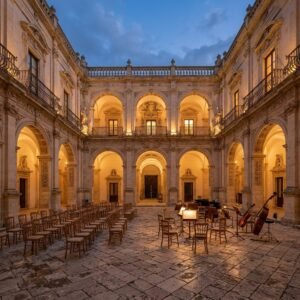
The heart of the palace is the Ballroom, also called the Orchestra Hall. It is in Rococo style, with mirrors, stuccoes, and frescoes by Matteo Desiderato and Sebastiano Lo Monaco. Its unique shape resembles a guitar, and it served as the ballroom for the wedding of Ignazio V. At the center, a small dome housed the musicians, reachable via a stucco staircase called a cloud-flake staircase. During the war, it was used as a tennis court by the English; a ball left a mark on the portrait of Princess Anna, still visible today. The Neapolitan ceramic floor and the overdoors with views of Naples make the room sumptuous.
Private Rooms and the Gallery of Birds
Among the most fascinating rooms are the Princess’s Apartment with rosewood boiseries and floors inlaid with Roman marble, and the Gallery of Birds, decorated with panels depicting various bird species and cartouches. There is also Don Quixote’s Room, with canvases inspired by Coypel’s engravings. Each room tells a piece of family history, such as the Hall of Fiefs with frescoes of the Biscari lands (Aci Castello, Misterbianco, Grammichele). The collections, once housed here, are now partly at Castello Ursino.
Why Visit It
There are three good reasons: first, it is one of the few noble residences still inhabited: visiting means entering a real home, not a cold museum. Second, the Ballroom is a unique Rococo masterpiece in Catania, with the hidden staircase and the fresco of the Family’s Glory. Third, you can see the private apartments (only on guided tour) with original furnishings and the Gallery of Birds, a gem for detail lovers. Moreover, the archaeological museum of Prince Ignazio is a story in itself, with artifacts now at Castello Ursino.
When to Visit
The most evocative time is late afternoon, when the seaside façade is bathed in warm light and the seven large windows seem to glow. Spring is ideal because the weather is mild and you can enjoy the city without the crowds. For a special experience, check the events calendar; there are often concerts in the hall with perfect acoustics and a Baroque atmosphere. Avoid the midday hours in summer, as it’s too hot.
In the Surroundings
Just a few steps away is Castello Ursino, where you can see the Biscari archaeological collections (coins, gems, armor). It’s worth a visit to complete the itinerary. Another stop is Via Crociferi, with its Baroque churches and the Benedictine Monastery, another prime example of Catania’s Baroque. If you have time, take a stroll to the Bellini Theater, a 10-minute walk away. All these places are connected by the thread of Catania’s 18th century.