Introduction
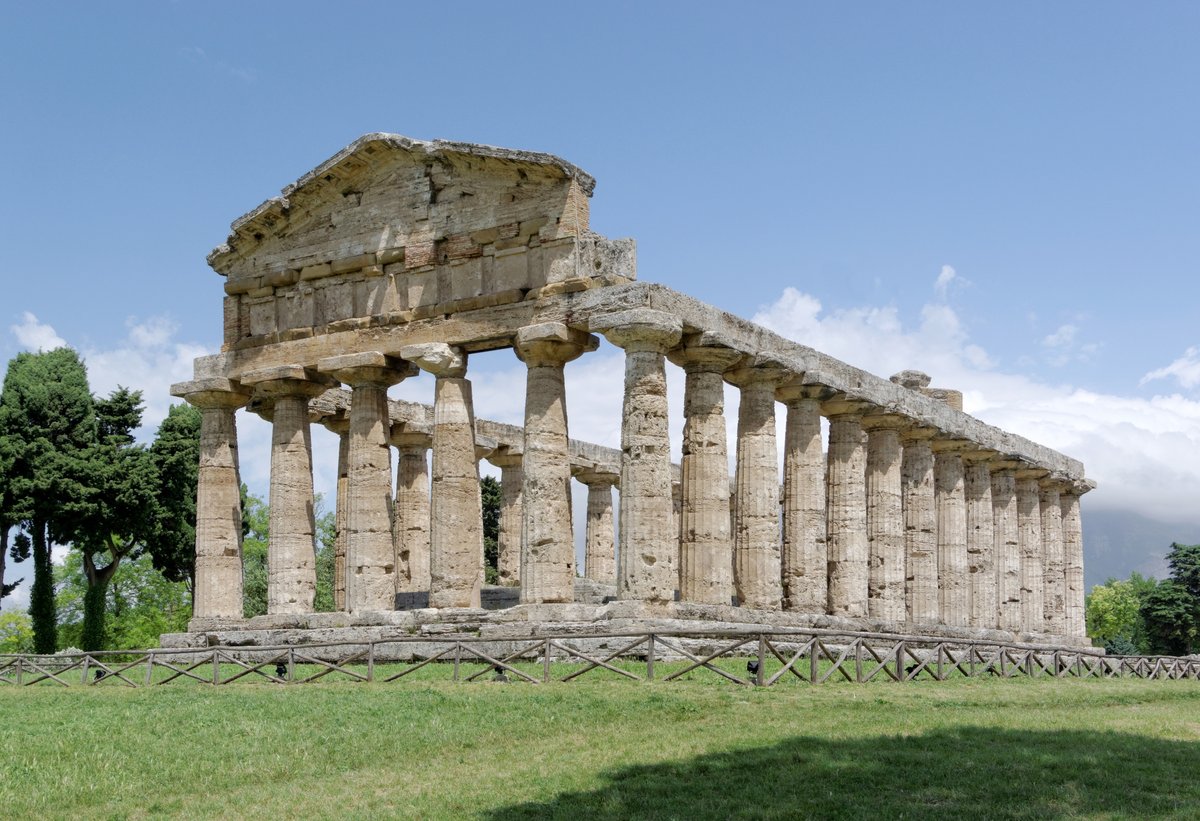
Arriving at the Temple of Athena in Paestum is a heart-stopping moment. It’s not just an ancient ruin; it’s a living presence that welcomes you with its Doric majesty. Those massive columns, some still perfectly intact, seem to defy the centuries. I stopped to gaze at it from afar before approaching, and I understood why it’s considered the best-preserved jewel of Magna Graecia. The emotion is palpable—you can almost hear the murmur of ancient Poseidonia. And then, that unique detail: it’s the only Greek temple that blends Doric and Ionic columns, a rarity that makes it even more special. It’s not just an archaeological visit; it’s a plunge into a past that still breathes.
Historical Background
The temple was built around 500 BC, when Paestum (then Poseidonia) was a thriving Greek colony. It is not dedicated to Athena by chance: the goddess of wisdom and war protected the city. Over time, the Romans repurposed it, but the Greek structure remained imprinted in the stone.
Its extraordinary preservation is also due to medieval abandonment, which saved it from dismantling. It was rediscovered in the 18th century, quickly becoming a star of the Grand Tour. Today, recent studies suggest it may also have been dedicated to Ceres, showing how cults blended. A timeline for orientation:
- 500 BC: construction of the temple in honor of Athena
- 273 BC: Paestum becomes a Roman colony, the temple is reused
- 9th century: abandonment and oblivion
- 1762: rediscovery during Bourbon excavations
- Today: UNESCO heritage site and destination for thousands of visitors
The Charm of Mixed Columns
What strikes you, beyond the sheer size, is the play of styles. The outer columns are Doric, robust and without a base, while those of the pronaos (the entrance) are Ionic, more slender and with volute capitals. It’s a detail that few notice immediately, but once it’s pointed out, you won’t forget it. Walking around it, I tried to imagine the architects of the time: why this choice? Perhaps an experiment, or a symbol of cultural encounter. The Doric columns, almost 9 meters high, still have clearly visible vertical grooves (fluting), a sign of impeccable craftsmanship. Inside, you could make out the spaces for cult statues. A tip: look at them against the light, at sunset; the limestone takes on incredible golden hues.
The Archaeological Context: More Than Just a Temple
The Temple of Athena is not an isolated structure, but the heart of a larger sacred area. Surrounding it, you can see the remains of the altar for sacrifices and small votive buildings. The location is strategic: it stands on a gentle hill, overlooking what was once the city’s agora. This made it visible from afar, a religious beacon. Heading south, you’ll encounter the Greek walls, still impressive. I’ve noticed that many visitors stop only at the temple, but take some time to wander the surroundings: there are statue bases and inscriptions that tell of daily life. The temple was likely accompanied by a sacred grove, of which no trace remains today, but which must have added an aura of mystery. It’s this ensemble that gives a sense of a living place, not just a monument.
Why Visit It
Three concrete reasons not to miss it. First: it’s a unique example of Greek architecture in Italy, with that Doric-Ionic fusion you won’t find elsewhere. Second: the state of preservation is exceptional; many columns are complete, and you can immediately understand how it was structured. Third: the single ticket for the archaeological area is a bargain: for a few euros, you also get to see the Temple of Neptune and the so-called Basilica, plus the museum with artifacts. Personally, I appreciated that it’s accessible and well-explained (there are clear panels). And then, there’s a magic in seeing it stand out against the blue sky of the Piana del Sele: a postcard you won’t forget.
When to Go
Avoid the midday hours in summer, when the sun beats down intensely and the area turns into a furnace. The best time is early morning, when the slanting light highlights the stone textures and there are fewer crowds. In spring and autumn, the weather is perfect for leisurely strolls. In winter, if you catch a clear day, the atmosphere is melancholic and evocative. I visited in late October: the grass was still green, the air crisp, and I could enjoy the temple in relative solitude. A secret? Towards sunset, the shadows lengthen and the site takes on a pink hue, a spectacle worth the trip.
In the Surroundings
A visit to the Temple of Athena can serve as the starting point for exploring other gems. Just a stone’s throw away is the National Archaeological Museum of Paestum, where you can admire the metopes from the Temple of Hera and the famous Tomb of the Diver. For a thematic experience, head to the Early Christian Basilica of Santa Maria a Mare in Capaccio, a lesser-known but fascinating site with well-preserved mosaics. If you want to combine archaeology and nature, the Foce Sele Nature Reserve offers walks among reed beds and history (nearby are the remains of the Sanctuary of Hera Argiva). These are all places that enrich the context, showing how this area was a crossroads of cultures.