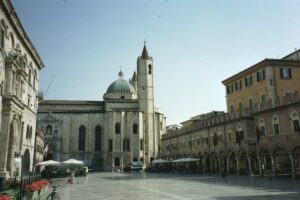
The Francesco Podesti Civic Art Gallery, housed in Palazzo Bosdari, is the artistic jewel of the Marche region. It features masterpieces by Titian, Crivelli, Lotto, and Guercino, along with a rich modern art section. Following recent restoration work, the museum reopened in December 2025 with a new layout.
– Admire Titian’s Gozzi Altarpiece, the artist’s first signed work.
– Discover the Sacra Conversazione (Pala dell’Alabarda) by Lorenzo Lotto.
– Be amazed by Carlo Crivelli’s Madonna and Child.
– Explore the Modern Art Gallery with works by Cagli, Trubbiani, and Cucchi.
Introduction
Entering the Pinacoteca Civica Francesco Podesti means diving into Marche art, among masterpieces that leave you breathless. Housed in the 18th-century Palazzo Bosdari, the collection has been restored to its former glory after the 2025 renovation. Here you’ll find Titian, Lorenzo Lotto, Carlo Crivelli, and many others, in a journey from the Middle Ages to the contemporary era. It’s a museum that tells the story of Ancona, its sea, its history. The atmosphere is intimate, almost private: you feel like you’re discovering a hidden treasure.
Introduction
Entering the Pinacoteca Civica Francesco Podesti means diving into Marche art, among masterpieces that leave you breathless. Housed in the 18th-century Palazzo Bosdari, the collection has been restored to its former glory after the 2025 renovation. Here you’ll find Titian, Lorenzo Lotto, Carlo Crivelli, and many others, in a journey from the Middle Ages to the contemporary era. It’s a museum that tells the story of Ancona, its sea, its history. The atmosphere is intimate, almost private: you feel like you’re discovering a hidden treasure.
Historical Notes
The art gallery was founded in
1884 thanks to the painter Francesco Podesti, who donated a core collection to the city. Initially housed in the convent of San Domenico, it was destroyed by the bombings of 1943. The masterpieces were saved in the fortress of Sassocorvaro. After various relocations, in
1973 it found its home at Palazzo Bosdari. Between 2023 and 2025, thanks to PNRR funds, it was completely refurbished with new facilities and tactile pathways. Here are the key moments:
- 1884: Foundation of the art gallery
- 1943: Destruction of the original site
- 1973: Transfer to Palazzo Bosdari
- 2025: Reopening after restoration
Historical Notes
The art gallery was founded in
1884 thanks to the painter Francesco Podesti, who donated a core collection to the city. Initially housed in the convent of San Domenico, it was destroyed by the bombings of 1943. The masterpieces were saved in the fortress of Sassocorvaro. After various relocations, in
1973 it found its home at Palazzo Bosdari. Between 2023 and 2025, thanks to PNRR funds, it was completely refurbished with new facilities and tactile pathways. Here are the key moments:
- 1884: Foundation of the art gallery
- 1943: Destruction of the original site
- 1973: Transfer to Palazzo Bosdari
- 2025: Reopening after restoration
Absolute Masterpieces
The collection is one of the most important in the Marche region, with three standout pieces. Titian’s Pala Gozzi (1520) is his first signed and dated work: an apparition of the Virgin among saints with intense colors. Then there’s Carlo Crivelli’s Madonna and Child, a late Gothic jewel with gold leaf that seems to illuminate the room. And Lorenzo Lotto’s Pala dell’Alabarda (1539), a Holy Conversation full of psychological introspection. Don’t miss Podesti’s Oath of the Anconetans, a monumental work recounting the city’s resistance.
Absolute Masterpieces
The collection is one of the most important in the Marche region, with three standout pieces. Titian’s Pala Gozzi (1520) is his first signed and dated work: an apparition of the Virgin among saints with intense colors. Then there’s Carlo Crivelli’s Madonna and Child, a late Gothic jewel with gold leaf that seems to illuminate the room. And Lorenzo Lotto’s Pala dell’Alabarda (1539), a Holy Conversation full of psychological introspection. Don’t miss Podesti’s Oath of the Anconetans, a monumental work recounting the city’s resistance.
The New Layout
The recent restoration has transformed the art gallery. Now the entrance is from Vicolo Foschi, with a modern ticket office. The rooms have been reopened to the public after years, with a chronological journey from the Middle Ages to contemporary art. The new room dedicated to Francesco Podesti on the ground floor stands out, featuring sketches and his masterpiece. LED lighting enhances every detail, and there are tactile paths for the blind, created in collaboration with the Omero Museum. An experience that combines tradition and innovation.
The New Layout
The recent restoration has transformed the art gallery. Now the entrance is from Vicolo Foschi, with a modern ticket office. The rooms have been reopened to the public after years, with a chronological journey from the Middle Ages to contemporary art. The new room dedicated to Francesco Podesti on the ground floor stands out, featuring sketches and his masterpiece. LED lighting enhances every detail, and there are tactile paths for the blind, created in collaboration with the Omero Museum. An experience that combines tradition and innovation.
Why Visit
Three good reasons: first, see the Renaissance masters live in an intimate setting, without the crowds of big museums. Second, discover the history of Ancona through the artworks, from the connection with Venice to the Risorgimento. Third, take advantage of the cumulative ticket (€6) which also includes the City Museum, perfect for understanding the context. Plus, the art gallery is accessible and offers guided tours even in English. In short, an art immersion that never tires.
Why Visit
Three good reasons: first, see the Renaissance masters live in an intimate setting, without the crowds of big museums. Second, discover the history of Ancona through the artworks, from the connection with Venice to the Risorgimento. Third, take advantage of the cumulative ticket (€6) which also includes the City Museum, perfect for understanding the context. Plus, the art gallery is accessible and offers guided tours even in English. In short, an art immersion that never tires.
When to Go
The best time? Late afternoon, around 4-5 pm, when light streams through the windows of Palazzo Bosdari and ignites the colors of the paintings. In winter, Sunday afternoons are quiet; in summer, take advantage of evening openings until 7 pm (or until 7:45 pm in some periods). Avoid Monday, when it’s closed. If you love peace and quiet, choose a weekday: you’ll often find yourself almost alone in front of the masterpieces.
When to Go
The best time? Late afternoon, around 4-5 pm, when light streams through the windows of Palazzo Bosdari and ignites the colors of the paintings. In winter, Sunday afternoons are quiet; in summer, take advantage of evening openings until 7 pm (or until 7:45 pm in some periods). Avoid Monday, when it’s closed. If you love peace and quiet, choose a weekday: you’ll often find yourself almost alone in front of the masterpieces.
Nearby
After the art gallery, walk to Duomo di San Ciriaco (10 minutes on foot), with its Romanesque-Gothic façade and spectacular view of the port. Alternatively, visit the Museo Archeologico Nazionale delle Marche just steps away, to see Picene and Roman artifacts. If you have more time, head down to the Mole Vanvitelliana, the iconic pentagonal building on the water that hosts temporary exhibitions. All in the historic center, all within walking distance.
Nearby
After the art gallery, walk to Duomo di San Ciriaco (10 minutes on foot), with its Romanesque-Gothic façade and spectacular view of the port. Alternatively, visit the Museo Archeologico Nazionale delle Marche just steps away, to see Picene and Roman artifacts. If you have more time, head down to the Mole Vanvitelliana, the iconic pentagonal building on the water that hosts temporary exhibitions. All in the historic center, all within walking distance.