Montechiarugolo Castle: fortress and residence on the Enza

Montechiarugolo Castle is a medieval manor overlooking the Enza stream, just a few kilometres from Parma, rebuilt in the 15th century by Guido Torelli and transformed into a noble residence in the 16th century. It can be visited with a guide in about an hour, including frescoed halls, the panoramic loggia and the patrol walkways, with a full ticket at 10 euros. It is part of the Castles of the Duchy of Parma, Piacenza and Pontremoli circuit and stands in a village awarded among the most beautiful in Italy.
• The 15th-century loggia with sandstone columns overlooking the Enza park
• The Hall of Festivities and the Middle Chamber with the Annunciation
• The patrol walkways with arrow slits and the ancient prison
• The legend of the Fairy Bema, still much told today


Events nearby

Copertina itinerario Montechiarugolo Castle: fortress and residence on the Enza
Montechiarugolo Castle on the Enza, near Parma: crenellated walls, frescoed halls and the legend of the Fairy Bema. Guided tours for 10 euros, a village among the most beautiful in Italy.

Good to know


Introduction: Montechiarugolo Castle, fortress and residence on the Enza

Montechiarugolo is one of those villages that stay with you. You arrive amid the countryside of the Val d’Enza, on the border between the Parma and Reggio areas, and suddenly you see Montechiarugolo Castle rising on the left bank of the stream: massive walls, Ghibelline battlements, two inner courtyards, and a loggia that seems to float above the greenery. It is not just a fortress: it is a noble residence, with frescoed halls, furnishings, eighteenth-century statues, and a legend that still circulates today. The village is one of the Most Beautiful Villages in Italy, and you immediately understand why: just a few metres, an ancient church, parking outside the walls, and the castle there, dominating everything. The guided tour is the right way to enter the noble apartment and the walkways. Full ticket costs 10 euros, reduced 7 euros; children aged 0-5 enter free. A perfect place for a trip out of Parma, without fake monumentality: here history is something you can touch.

A Brief History: Sanvitale, Torelli, and the 1796 Battle

The first traces of the garrison date back to 1121, when the Sanvitale family built a fortress to defend the Val d’Enza. In 1313 Giovannino Sanvitale rebelled against the Guelphs of Parma: the castle was besieged and destroyed. After Parma entered the Duchy of Milan, the Viscontis had it rebuilt. In 1406 Giovanni Maria Visconti granted Montechiarugolo and Guastalla to Guido Torelli, who began rebuilding it on a polygonal plan; in 1428 came the title of count. In the sixteenth century Pomponio Torelli transformed the stronghold into a noble residence, but in 1611-1612 his son Pio was accused of conspiring against Ranuccio I Farnese: conviction, confiscation and the end of the county. On 4 October 1796 the castle was the scene of the Battle of Montechiarugolo, where an Austrian column was defeated by troops of the Reggiana Republic. Under Marie Louise it became a military warehouse and powder magazine; in 1864 it passed to Antonio Marchi. During the Second World War, one wing served as a civilian internment camp.

  • 1121 first Sanvitale garrison
  • 1313 destruction
  • 1406 fief granted to Guido Torelli
  • 1428 county
  • 1612 end of the Torelli family
  • 1796 battle
  • 1864 Marchi family

Walls, bridges and walkways: the fortress on the Enza

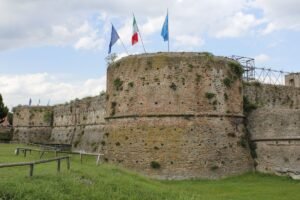
The first thing that strikes you is the circuit of walls: brick walls crowned with Ghibelline merlons, a moat, and two ravelins. The castle has an irregular plan and develops around two courtyards, the courtyard of honour and the well courtyard. In the courtyard of honour there is a 15th-century portico and at its centre two 18th-century statues from the Royal Palace of Colorno. The valley-facing side is the most scenic: a projecting loggia with small sandstone columns, frescoed with Torelli and Visconti coats of arms, from which you look out over the Enza and the landscape as far as Montecchio and Quattro Castella. The patrol walkways are covered and full of arrow slits; a trapdoor leads to a cramped prison, the Tombazza. From the courtyard you go up to the Castellazzo, the bastion transformed into a garden with hedges, rose beds, and peonies. Don’t expect a hushed museum-like castle: here you can still sense the logic of a fortress, with the Renaissance elegance that was added later.

Frescoed Halls and the Legend of the Fairy Bema

The rooms tell the story of the castle’s transformation from fortress to residence. The Hall of Festivities is frescoed by the school of Cesare Baglioni, with grotesques and coats of arms; the Middle Room preserves a 15th-century Annunciation in the Gothic-Lombard style. Then there are the Hall of the Four Elements, also known as the Hall of the Sirens, with a painting of a boat inspired by the Odyssey, and the Room of Cats, decorated with lozenges and the rampant lion of the Torelli family. In the Ancient Room, the frescoes speak of human life and the hours of the day. But the mysterious heart is the Little Room of the Fairy Bema, where an Egyptian mummy is kept that tradition identifies with Bema. Legend says that in 1593 the young woman predicted the beheading of Pio Torelli; then, every year on the night between 18 and 19 May, her ghost is said to appear on the keep. Believe it or not, the atmosphere changes.

Why Visit It

Three concrete reasons. First: it is a castle that is still privately owned and lived in, not an empty film set; the guided tour lasts about an hour and takes in halls, loggia and walkways at a human pace. Second: the village of Montechiarugolo is listed among the Most Beautiful Villages in Italy, and walking from the outside car park, with no traffic, is already half the trip. Third: it is pet-friendly in the open areas and on the walkways, with dogs kept on a leash; small dogs can be carried in the halls, while larger ones wait in the courtyard with a bowl of water. Add that the castle is part of the Castles of the Duchy of Parma, Piacenza and Pontremoli circuit and that the visit is also suitable for those with little time: full ticket €10, reduced €7. It is not the usual postcard castle: it is a short but rich outing.

When to go

The castle is open from March to November, with guided tours mainly at weekends and on certain public holidays. If you can choose, aim for a clear, bright day, when from the loggia you can clearly see the Enza Valley and the outline of the hills. The time I find most evocative is late afternoon: the low light warms the bricks, the rooms are quieter, and the walkways offer a softer panorama. In spring the rose beds and peonies of the Castellazzo are at their best; in autumn, with the cool air, the village is silent and the castle seems even more solid. Avoid the middle hours of the hottest days, especially if you want to enjoy the loggia without hurry. It is always best to check the calendar on the official website, because opening hours vary from month to month and special visits must be booked.

In the Area

If you have half a day to spare, don’t stop at the castle alone. Nearby are the castles of Sala Baganza and Torrechiara, two stops that speak the same language of stone and hills; Torrechiara is the classic pairing for anyone who wants to continue the tour of the Parma area’s stately homes. For more greenery, the Parco del Torrente Enza offers waterside walks and views over the countryside, with the castle now and then reappearing through the trees. In the village of Montechiarugolo you can try the X-Scape Experience on the Road – Ricordi dal Passato, an open-air experience that plays with local history. And if you’re simply looking to relax, pause to look at the crenellated facade from below: it’s the simplest way to understand why this place has remained at the heart of the Val d’Enza for so long. No mileage, just ideas for extending your visit.

Itineraries nearby


💡 Did You Know…?

The legend of the Fairy Bema still enlivens the manor: according to tradition, on the night between 18 and 19 May her ghost appears on the keep awaiting the return of Pio Torelli. In the Fairy Bema Room an Egyptian mummy is preserved, long believed to be her body; popular tradition loves to repeat that anyone who does not want misfortune must not move it from its bed.