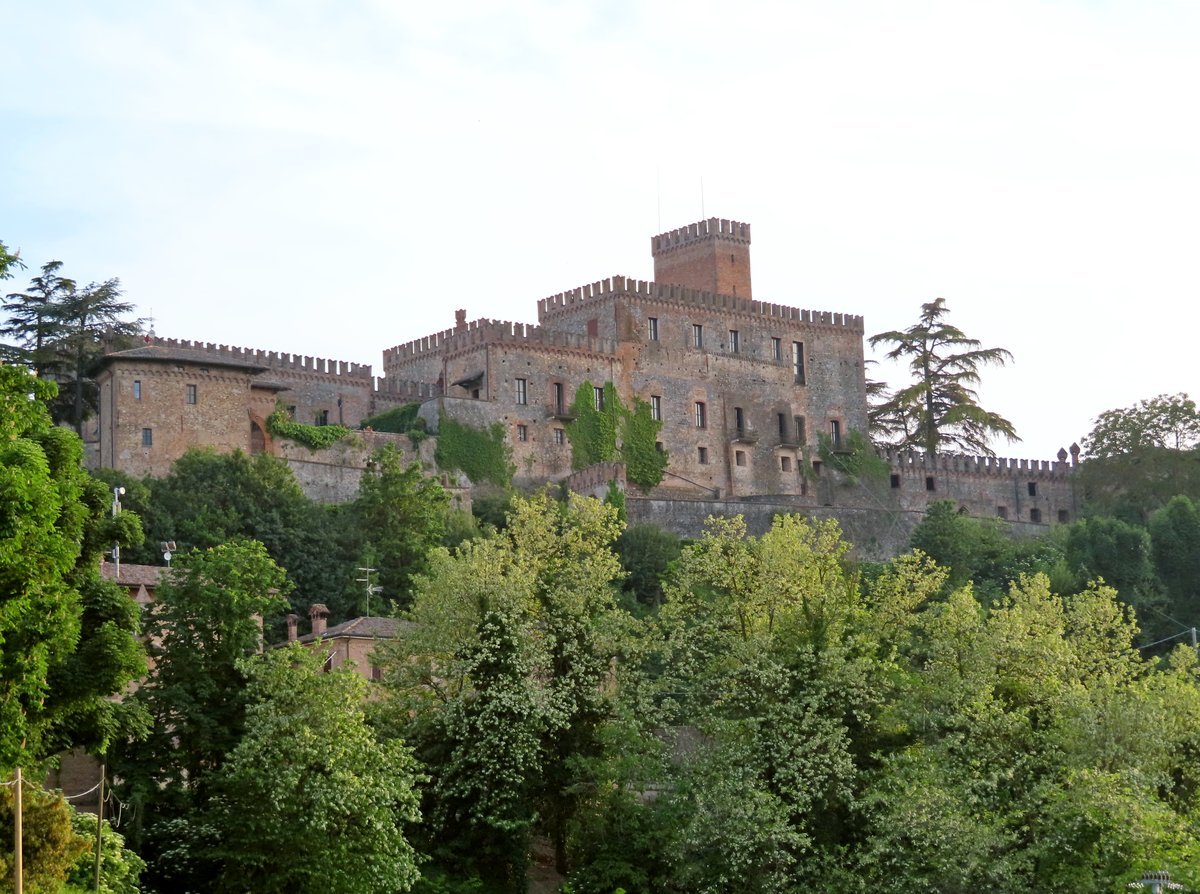
Castello di Tabiano is a medieval fortress overlooking the Po Valley from a rocky spur in Salsomaggiore Terme, in the province of Parma. Its origins date back to between the 10th and 11th centuries, and the manor served as a stronghold of the Marquises Pallavicino to defend the salt wells and control the Via Francigena. Today it is a private residence open for guided tours, events and weddings, with the village at its foot transformed into a Relais de Charme. – Towers and drawbridge: two circular 12th-century towers, stone perimeter walls and a 13th-century watchtower. – Frescoed halls and cellars: stuccoes, frescoes, fine floors, ballrooms, a library and a private chapel. – Panorama over the Alps: from the terraces, the view sweeps from the Po Valley to the Apennines and all the way to the Alps. – Guided tours: about 45 minutes, ticket €9–10, free for children up to 8 years old.
Castello di Tabiano, the Guardian of the Plain
Seen from afar, Castello di Tabiano still looks like a guardian today. It stands there on a rocky spur overlooking the Po Valley, a stone’s throw from Salsomaggiore Terme, and you only have to look up to understand why for centuries no one wanted to let it go. Two round towers, a stone curtain wall, a watchtower with a drawbridge: the image is that of a true fortress, not a romantic ruin. Then you go inside and discover that there is no dust and silence within, but frescoed halls, a theatrical grand staircase, and vaulted cellars with oak barrels. And outside, from the terraces, your gaze runs all the way to the Alps. It is a private residence, this must be said, but open for guided tours: to me it is one of the most evocative manors in the Tuscan-Emilian Apennines, and I don’t say that to cheerlead.
Historical Background
The origins of
Tabiano Castle go back to between the 10th and 11th centuries, when the
Pallavicino Marquises built it on an earlier Roman settlement to defend the
salt wells of Salsomaggiore and Tabiano and control the Via Emilia and the Via Francigena. Centuries of sieges and struggles between Guelphs and Ghibellines followed, with changes of hands involving the Terzi, the Cornazzano, the Visconti, and Emperor Frederick Barbarossa. From the 15th century a slow decline began. In the 19th century
Giacomo and Rosa Corazza bought and restored it, entrusting famous artists with stuccoes, frescoes, and fine floors; by the end of the century the restoration had taken on a neo-Gothic taste.
- 10th–11th c.: the Pallavicino build the stronghold to protect the saltworks
- 12th c.: two round towers; Solestella da Bardi, the Angel of Tabiano
- 13th c.: watchtower with drawbridge, the only access
- 14th–15th c.: disputes, sieges, and military decline
- 19th c.: restoration by the Corazza family, private residence and farm
The Towers, the Drawbridge and the Red Gate
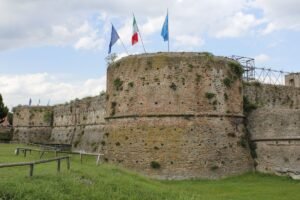
The best part is that the castle doesn’t hide its military origins. From the medieval fortress there remain two circular towers, to the south and north, dating from the 12th century, large stretches of stone curtain wall, and a 13th-century watchtower with the drawbridge, which until the late Middle Ages was the only entrance. Along the route you reach the so-called Red Gate, one of the passages that best tell the story of the complex’s defensive purpose. The guided tour lasts about 40–45 minutes and crosses the most interesting areas, helping you understand how the fortress was adapted over the centuries into a noble residence without losing its garrison-like character entirely. I confess I lingered longer than expected right in front of the watchtower.
Frescoed halls, wine cellars and terraces
Here the military section gives way to the residential one, and it’s the part that impressed me most. The route passes through the old vaulted cellars with oak barrels, the frescoed halls, the ballroom, the hall of coats of arms, the family library, the private chapel and finally the grand staircase, which is truly spectacular. The best moment? The terraces, from which your gaze sweeps over the Po Valley as far as the Alps, and the gardens around the property. The private chapel and the nearby parish church make the castle a popular setting for weddings: the civil ceremony can be held in the garden or in the cellars.
The Hamlet, the Relais and the Caseificio
Just below the castle stretches the Antico Borgo di Tabiano Castello, once linked to the estate’s agricultural activity. Today it is a Relais de Charme with rooms, suites and apartments (about sixty in all), meeting rooms, swimming pools and a wellness area with a natural grotto, plus an orchard, vegetable garden and herb garden. The restoration began after Parmigiano Reggiano production ended in 2005. Here you can dine at the Caseificio, housed in the old dairy, with typical zero-kilometre cuisine, and at Locanda del Colle. You can also buy local specialities. In the wine cellar, events for up to 250 people are organised, and outdoors there are 3 hectares of terraces, courtyards and park.
Why visit it
First, because it is one of the most imposing examples of feudal defensive architecture in Alta Emilia: 12th-century towers, stone walls, and a drawbridge are not something you find everywhere. Then because the guided tour is short and to the point, about 40-45 minutes, and takes you inside spaces that are usually closed: cellars with barrels, frescoed halls, the library, the chapel. And finally for the location: the view from the terrace stretches as far as the Alps, and below you have the village with its relais and restaurants, perfect for ending the day with something good. A practical note: admission costs 10 euros (9 reduced, free up to age 8), booking is recommended, and visits take place only with the castle guide.
When to go
The most evocative moment, I think, is the late-afternoon visit, at 4 or 5 pm: the low light brings the stones of the ramparts to life, and from the terrace the plain fills with colour, with the Alps behind if the air is clear. It’s true of autumn mornings too, when mist rises from the plain and the castle really does look like a rocky spur suspended in the air. Visits run on Saturdays and Sundays at 10 am, 11 am, 4 pm and 5 pm; from 1 April, Monday, Thursday and Friday at 5 pm are added, and the Sunday 10 am visit is in English. Note: times can change for private events, so it’s always worth checking the official calendar.
In the Surroundings
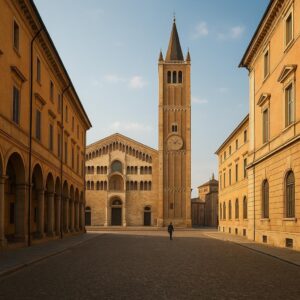
Staying on the same theme, the area is full of fortresses, parish churches, convents and villages to combine with your visit. Very close by is Salsomaggiore Terme, with its renewed spa wellness and the saltworks that for centuries were the very reason for the castle’s existence. If music interests you, the Verdi sites and the Busseto area nicely round out a day of cultural discovery. For a different break, there’s Fidenza Village, a commercial outlet, and the chance to go horseback riding or mountain biking. And then Parma, with its cathedral, baptistery and theatres: a city worth the trip on its own.