Forte Puin: History and Trekking in the Parco delle Mura

Forte Puin is the nineteenth-century fortified house that dominates the ridge between the Bisagno and Polcevera valleys, the first outpost outside the walls after Forte Sperone. Reopened in 2025 after a €720,000 restoration, it can be visited on Sundays with free admission and offers a 360-degree terrace over Genoa and the Parco delle Mura. From Righi it can be reached on foot via hiking trails, among walls, bastions and sea views. • Square tower and bastioned enclosure from 1815–1830 • Panoramic terrace over Genoa, Forte Diamante and Fratello Minore • Guided tours and historical re-enactments organised by Outdoor Experience • Trails of the Parco delle Mura for trekking and walks

Copertina itinerario Forte Puin: History and Trekking in the Parco delle Mura
Forte Puin, a nineteenth-century fortified house between the Bisagno and Polcevera valleys: open on Sundays, free admission, panoramic terrace and trails in the Parco delle Mura.

Good to know


Forte Puin: History and Trekking in the Parco delle Mura

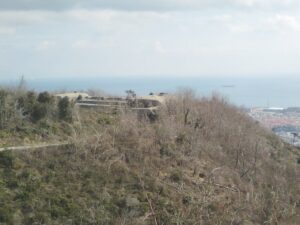
Forte Puin is a tower house-fort with a bastioned enclosure, set on the ridge between Val Bisagno and Val Polcevera at 500 metres above sea level. Coming from Righi, after Forte Sperone, it is the first fort beyond the city walls that you meet: not huge, but with a massive profile you notice straight away. The square tower, pentagonal bastions and earthworks tell a precise military story, while the surrounding landscape feels almost like moorland. What struck me was the terrace: from there your gaze sweeps over Genoa, the Ligurian Sea and the inland valleys, with Forte Diamante and Forte Fratello Minore in the background. Today the fort is open every Sunday from 10 am until sunset, with free admission, guided tours and special openings for groups and schools by appointment. It is managed by APS Outdoor Experience Genova.

Historical Background

Its origins lie in the fieldworks of 1747, during the War of the Austrian Succession. In 1806, Napoleonic engineers designed masonry fortifications on Puin and the Due Fratelli. From 1815, the Savoyard Corps of Engineers built three tower forts: Forte Puin, Fratello Minore, and Fratello Maggiore. The central tower was begun in 1815; the bastioned enclosure from 1818, with a southern entrance protected by a moat and drawbridge. Completed in 1830, it served to fill the gap between Forte Sperone and Forte Diamante. In the mid-19th century, the standing garrison was 28 soldiers, with another 45 possible; armament included 8 cm field guns, howitzers, stone-throwing guns, and small cannons. It was decommissioned in 1908. In the 1960s, architect Fausto Parodi restored it and lived there until the 1980s. After a €720,000 restoration, it reopened on 24 October 2025.

  • 1747: first fieldworks.
  • 1806: Napoleonic design.
  • 1815-1830: Savoyard construction.
  • 1908: military decommissioning.
  • 2025: reopening.

The tower, the ramparts and the cistern

The layout is compact and easy to follow: a two-storey central tower, covered by barrel vaults, within a rectangular enclosure with ramparts. Two pentagonal bastions flank the entrance, while three open onto the north side. The earthwork is raised and two brick ramps connect it to the parade ground. On the ground floor there are two rooms with a kitchenette; a service stair descends to the three small underground storerooms and rises to the second floor. The original entrance was protected by a drawbridge over the moat. The terrace is slightly sloped so that water drains towards a channel that fed the cistern; the scuppers have grilles. The 1960s restoration added partition walls, sanitary facilities and new railings. The complex measures 1,106 sq m and stands at 500 metres. The recent work recovered the terracotta, consolidated the vaults and parapets.

Panoramic terrace and trails in the Parco delle Mura

The part that left the strongest impression on me was the climb up to the roof: a steep staircase leads to a terrace with a brick parapet, opening onto a 360-degree view. You can see Genoa, the Ligurian Sea, the inland valleys, Forte Diamante and Forte Fratello Minore. The fort is part of the Parco delle Mura and can be reached from Righi along scenic trails; it is also the first fort outside the Walls after Forte Sperone. Hikers, school groups and military history enthusiasts pass through here. The surrounding environment has something of the Scottish moor about it, with open stretches and outcrops of rock. The City Council uses the fort as a fire lookout, and the structure serves as a shelter and rest stop. The trails mentioned in the sources are marked with a Red Diamond, Red Ring, Red X and hiking difficulty E; some sections are not signposted. Comfortable shoes and water are advisable.

Why Visit Forte Puin

If you’re looking for a practical reason, the first is that entry is free, and Sunday opening from 10 am until sunset makes it easy to include in a trip to Righi. The second: it is one of the best-preserved forts in Genoa’s 19th-century defence system, with a tower, ramparts, moat and drawbridge that are easy to make out. The third is the panoramic terrace, genuinely spacious, which alone repays the walk. What’s more, the association APS Outdoor Experience Genova organises guided tours, historical re-enactments, pack-animal treks, night hikes with stargazing, and family activities. It is not a dusty museum: it is a living place, used by hikers and schools. Special openings for groups and schools are on Wednesdays and Fridays by appointment. In my view, it is worth visiting even just to understand how Genoa defended itself from the ridge.

When to go

The terrace is at its best when the air is clear: after a storm, with a clean sky, the sea and valleys are easier to make out. I’d avoid the central hours of a hot day, because the embankment and walkways don’t offer much shade. I prefer the late afternoon, when the slanting light highlights the bricks and the panorama warms up. An early morning can also be beautiful, but you have to take Sunday opening hours into account. If the fort is closed, the exterior and the paths are still visitable all year round. Check the weather: with fog or rain the ridge loses much of its charm, and the paths become slippery. On a windy day, on the other hand, the sky often clears and the view is sharper.

Nearby

From Forte Puin, you can continue along the ridge of the Parco delle Mura and reach Forte Sperone, which once marked the northern edge of the city walls, or head towards Forte Diamante. These are real places, linked by the trails of the Strada dei Forti, and together they help make sense of Genoa’s defensive system. Another option is to stop at Righi, the starting point of the Zecca–Righi funicular and a natural gateway to these routes. The area is popular with hikers, families and school groups; don’t expect a village with amenities everywhere. Bring water and suitable shoes. If you have time, sources cite the Ostaja de Baracche as a reference point near the Puin place name: useful for anyone who wants to round off the walk with something more substantial.

Itineraries nearby


💡 Did You Know…?

The name Forte Puin remains a small mystery: some link it to the ‘Ridotta del Pani’, others to the ‘baracca del Paolino’ and others to the local dialect word ‘padrino’. A curious detail is that in the 1960s the architect Fausto Parodi restored it at his own expense and lived there for about twenty years, turning a military barracks into a home. Today the terrace is also used by the City Council for fire spotting.