Forte Begato is the most imposing fortified barracks in Genoa’s Savoy system: a quadrangular plan, four bastions and a masonry bridge in place of the drawbridge. It is best explored from the outside, among ramparts, moats and panoramas over the Valpolcevera and the port, with pedestrian access from Righi or San Quirico. The interiors are not regularly open, but events and guided tours make them accessible on special occasions.
– Military architecture: multi-storey barracks, central courtyard and corner bastions.
– Open panoramas: views over the Valpolcevera, the port and nearby forts.
– Park of the Walls: CAI trails and routes within Genoa’s fort system.
– Living history: a prison during the Great War, an anti-aircraft battery and recent restoration.
Forte Begato: the Savoy barracks that dominates Genoa
Forte Begato is no ordinary postcard castle: it is a large fortified Savoy barracks, planted on a ridge above Genoa. Its plan is square, with four bastions at the corners, and the whole structure can be made out from afar. From up here, your gaze runs over the Valpolcevera on one side and over the port and the Lanterna on the other. Access is via a masonry bridge that replaced the old drawbridge, in front of a portal in Finale stone. Inside, the central courtyard and the massing of the barracks tell of a military machine rather than a palace. The interiors are not always open: they are often visited only on special occasions. For this reason too, arriving outside event times has a slightly more adventurous flavour. The setting is that of the Parco delle Mura, among meadows, paths and other fortifications.
Historical background
The plateau known as Piano delle Fosse was already strategically important in medieval times and during the French siege of 1507. In 1625 fieldworks were prepared; the following year the Republic of Genoa began the New Walls, which incorporated three bastions. After annexation to the Kingdom of Sardinia, in 1815 the Savoy Corps of Engineers designed the quadrangular barracks: construction began in 1818 and was completed around 1830. In the early 1830s the outer enclosure was added, with a moat and drawbridge. During the First World War the fort served as a prisoner-of-war camp for Austro-Hungarian troops; in the Second World War it housed an anti-aircraft battery, and in 1941 an English bombing raid destroyed one bastion. After the war it was abandoned and later used as a warehouse. Restoration took place between 1993 and 2004, periodic openings began in 2014, and today a redevelopment project is under way.
- 1626: New Walls
- 1818-1830: Savoy barracks
- 1832-1836: outer enclosure
- 1941: bastion destroyed
- 1993-2004: restoration
A three-tier military machine
The barracks form the heart of the complex: a quadrangular plan, four corner bastions and a central courtyard overlooked by the quarters. The structure rises over three levels: the lower two are casemated—enclosed, protected spaces—while the upper level is open-air with artillery platforms. The terrace was shielded by a pitched slate roof, restored during conservation work. Outside opens a large parade ground with stands, ditches and earthworks. Very beautiful, though often closed, are the barrel-vaulted chambers between the bastions and the monumental staircases linking the floors. At the corners stand large brick arch crosses with lunettes, a solution that enables vertical connections and recalls the Specola Tower. The ordinary garrison numbered about 340 men, but in an emergency it could exceed 800. Don’t expect empty, museum-like halls: here it is the mass of masonry that counts.
The Belvedere Over Two Worlds
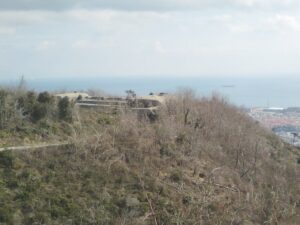
The whole point is here: Forte Begato sits on a plateau along the ridge that separates Valpolcevera from central Genoa. To the west the valley opens up; to the south you can make out the port with the Lanterna; to the east the other forts along the ridge line up, such as Sperone and Castellaccio. On clear days the view reaches Monte Beigua, Monte Antola and the Maritime Alps. The name comes from the locality of Begato, below the fort, in the Rivarolo district. You can get there from Righi along Via del Peralto, or on foot along the paths of the old city walls; another historic access route is from Valpolcevera, via San Quirico. It is not a “finished” place: there are meadows, walls, a few recent buildings outside the perimeter and a strong sense of a boundary between city and mountain. For me, the best moment is when the wind clears the air.
Why visit it
First reason: it is one of the most readable parts of the Genoa Forts system, with a Savoy barracks still recognisable in its square plan and four bastions. Second: the view is genuinely wide, bringing together port, valley and ridge in a single glance. Third: the area is popular with hikers and mountain bikers, especially thanks to the trails of the Parco delle Mura and the Bike Hub opened nearby. You don’t need a ticket to enjoy the exterior: you can walk among meadows, ramparts and mighty walls. The interiors, however, are not regularly open to visitors; keep an eye out for special openings, FAI Days, Rolli Days or events such as OctoberFort. On those occasions the fort changes face and becomes a stage.
When to go
I wouldn’t pick just any time. A clear day is better, perhaps after rain has washed the air clean: from up there, the harbour and the Valpolcevera read far better. Mornings are quieter and the light is soft and even; late afternoon, by contrast, stretches shadows across the bastions and warms the stone walls. In summer, it’s best to set off early, as the ridge is exposed and the sun beats down. In winter, when the sky is clear, the contrast between the meadows and the blue is striking. I’d avoid hazy days: the view is the main reason for the climb. If there are evening events, the fort’s dramatic lighting adds another dimension, but access should always be checked.
Nearby
The fort is already inside the Parco delle Mura, the 19-km ring of walls that embraces Genoa. From here you can continue to Forte Sperone, another stronghold on the ridge, or take the path toward Forte Diamante via Forte Puin. These are scenic walks through woods and along ridgelines, with spots where the city feels very far away. Another idea is the Muce – Museo di Certosa, linked to the fort by an augmented-reality project: it isn’t just around the corner, but it pairs well with this kind of visit. If you’re looking for something less military, the meadows around the fort are a destination in themselves: sit down, look out over the port, and let time pass.