Forte Quezzi: Ruins and Views over Genoa

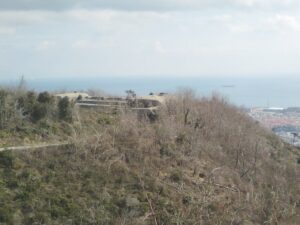
Forte Quezzi is an 18th-century military ruin on Colle della Calcinara, at about 285 m above the Val Bisagno. The perimeter walls, the Savoy barracks and a stone bastion remain, set in a pine forest with views over Genoa. Visits are open and free, but suitable shoes and caution among the ruins are essential.
• History: designed by Jacques de Sicre in 1747, rapidly completed in 1800 and extended under Napoleon.
• Views: views over Quezzi, Marassi, Staglieno and the Val Bisagno.
• Nature: a Site of Community Importance (SIC) with the rare tarantolino and trails towards Forte Monteratti.
• Access: on foot from Quezzi or Sant’Eusebio, by car from Biscione.

Copertina itinerario Forte Quezzi: Ruins and Views over Genoa
Forte Quezzi in Genoa: an 18th-century military ruin on Colle della Calcinara, amid walls, a Savoy barracks and views over the Val Bisagno. Free access from Quezzi, Sant’Eusebio or Biscione.

Good to know


Forte Quezzi: ruins and views over Genoa

Forte Quezzi stands 285 metres above sea level on Colle della Calcinara, and it is not one of those ruins tidied up for tourists. You reach it among pine trees, crumbling walls and silence, with the Val Bisagno opening up below. The first thing that strikes you is the contrast: the eighteenth-century walls above, the Biscione with its long bends below. There are no ticket offices or marked trails, and perhaps that is precisely its charm. You walk cautiously among stones, earth and the remains of the barracks, imagining the soldiers and the emergency works of the 1800s. The visit is free and the site is always accessible, but it must be treated as an abandoned place: no fountains, no refreshments, proper shoes and eyes open. For me it is a Genoa off the beaten track, perfect for anyone seeking a rugged panorama and military history without frills.

Historical background

The idea originated in 1747, during the War of the Austrian Succession, when Genoa feared the Austro-Piedmontese army. On 27 August, engineer Jacque de Sicre announced the start of work on the ridge, but funding and plans soon stalled. In 1800, during the siege of Genoa, General Andrea Massena ordered its restoration: according to tradition, the fort was put up in three days and three nights using barrels filled with earth and dry-stone walls. In 1809, a stone bastion and a two-storey barracks were added. After annexation to the Kingdom of Sardinia, it was armed with two 16-pounder cannons and three long howitzers. Then came decline: limited usefulness in 1830, a Mazzinian attempt in 1857, ‘little value’ in 1875. In wartime the upper floor was demolished for anti-aircraft use; today only the walls and a shelter for flocks remain.

  • 1747: Jacque de Sicre’s plan
  • 1800: reconstruction under Massena
  • 1809: Napoleonic expansion
  • 1814-15: Kingdom of Sardinia
  • 1830-1875: negative assessments
  • 1914: granted to private owners
  • WWII: anti-aircraft use and abandonment

Inside the ruin: drawbridge and barracks

The main entrance faced the Bisagno Valley and was protected by a drawbridge that is unrecognizable today, topped by a Savoy coat of arms. The entrance hall housed the guardhouse quarters; a staircase led to the inner courtyard, overlooked by the two-storey barracks. Today, the most legible feature is the ground-floor perimeter, filled with earth and debris, while the single-storey casemate retains a vaulted roof. De Sicre’s design called for a square plan with a hornwork and pentagonal demi-bastions, but the narrow ridge forced the shape to be compressed and the front bastions to be made irregular. The area is about 3,000 sq m. Don’t expect rooms you can visit: it is a ruin, and the way to read it is to walk around it. This very incompleteness tells the story of military haste and on-the-ground adjustments better than a museum.

The Biscione at the Foot of the Fort

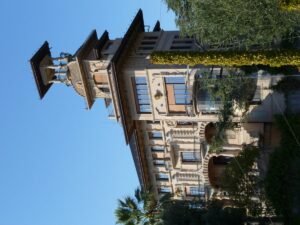
Beneath Forte Quezzi lies another piece of history, very much of the twentieth century: the INA-Casa neighbourhood known as the Biscione. Designed by Luigi Carlo Daneri with Eugenio Fuselli, it was built between 1956 and 1968 and was intended to house around 4,500 residents in 880 dwellings. Its five curving blocks follow the slope; block A, the longest, runs for more than 500 metres and has an internal road on the third floor that serves as a promenade architecturale. The large communal loggia is one of Genoa’s most disorienting belvederes: the city and sea on one side, the military ruin on the other. Not everyone likes this outsized scale, and I understand the criticism of its density; yet the dialogue between Rationalist architecture and eighteenth-century walls is unique. As you pass through Quezzi or the Biscione, look up: the fort seems to watch over the neighbourhood, or perhaps the other way round.

Why visit it

Three concrete reasons. First: entry is free and the site is always accessible, with no guided tours or fences. Second: the views, stretching over the Bisagno Valley, Quezzi and Marassi and toward the Staglieno hill; it is one of the places where you understand Genoa’s vertical geography. Third: the contrast with the Biscione and the old military road that links other forts, such as Monteratti, Richelieu and Sperone. On top of that there is nature: the area is a Site of Community Importance for the European leaf-toed gecko, a small protected gecko that lives among the walls. It is not a trip for everyone: steep path, suitable shoes, no drinking fountain. But if you are looking for a real, overlooked and photogenic place, this is more interesting than many manicured attractions.

When to go

I wouldn’t choose the middle hours of a hot day: the fort is exposed and offers no shelter. Better the early morning, when the slanting light makes the walls emerge from the pine grove, or late afternoon, as the Bisagno Valley glows with colour. A dry, clear day is ideal, because the view is half the visit and haze ruins it. On mild days the route is more pleasant, but avoid the mud after rain anyway: some stretches of earth and stones become slippery. On hot days bring water; on the ridge you feel the wind. If you can, go slowly and without the anxiety of ‘doing’ the fort: it is a place to absorb, not to complete. And remember that there are no refreshment facilities.

Nearby

If you still have legs, the first detour is the nearby Torre Quezzi: a 17-metre-high cylindrical brick tower, built by the Sardinian Corps of Engineers between 1818 and 1823 as an outwork, separate from the fort yet complementary to it. Today it is a shelter for sheep and a Site of Community Importance for the tarantolino gecko, so it should be observed with respect. Another idea is to head down towards the Monumental Cemetery of Staglieno, whose hill can be clearly seen from the fortification: the fort militarises the landscape, while Staglieno tells it in another way. Alternatively, follow the old military road towards Forte Monteratti and the other Genoese forts, without expecting services or perfect signage. These are real places, a little rough around the edges, that add meaning to the visit. Don’t look for a packaged tourist route: here the beauty lies in surprise.

Itineraries nearby


💡 Did You Know…?

Tradition says that in 1800 Massena had the fort rebuilt in three days and three nights using barrels filled with earth and dry-stone walls, surprising the enemy. In 1857, some followers of Mazzini tried in vain to occupy it. Today the rare tarantolino finds refuge among the walls, while nearby Torre Quezzi, dating from 1820, has become a shelter for flocks.