From the centre of Alessandria you arrive by crossing Richard Meier’s white bridge: ahead appears a stone star on the Tanaro, with six bastions, moats and 60 hectares of history. Built by the Savoys from 1732 to a design by Ignazio Bertola, it is among the largest lowland fortresses of eighteenth-century Europe. Admission is free: you walk among the Piazza d’Armi, galleries and museum.
– Six star-shaped bastions and the great moat once flooded by the Tanaro
– The bastion of the first Tricolour, raised on 10 March 1821
– The 22,000 m² Piazza d’Armi and the Governor’s Palace
– Meier’s bridge and the Royal Army Museum
Introduction
You arrive at Richard Meier’s white bridge, leave Alessandria’s traffic behind, and find yourself facing a hexagon of brick and earth that looks like it came straight out of a military engineering manual. The Citadel hits you quietly: sixty hectares of walls, moats, and bastions where time seems to have stood still. It is the only flatland fortress built by the House of Savoy in the eighteenth century and, rare thing, it is still set within its original context, with no buildings or ring roads suffocating it. You can walk along the earthworks, look out at the Tanaro, and understand why the site has been on UNESCO’s Tentative List since 2006. This is not your classic postcard monument: it is a vast place, rough around the edges in parts, to be explored slowly and in comfortable shoes. And then there is the detail that changes everything: the first Italian tricolour was flown here.
Historical Background
After the Treaty of Utrecht in 1713, Alessandria passed to the House of Savoy. Victor Amadeus II allocated 421,642 lire and entrusted the project to military engineer Ignazio Bertola: work began on
4 September 1732 and lasted about fourteen years, erasing the Bergoglio district. The fortress was to guard the Road of Flanders. In 1745 it withstood a seven-month Franco-Spanish siege, in 1799 it fell under Austro-Russian bombardment, then Napoleon expanded it and turned it into an arsenal. On
10 March 1821, the tricolour was raised on the bastions for the first time by the rebels led by Lieutenant Colonel Guglielmo Ansaldi. In 2007 it was decommissioned from military use.
- 1713 – Alessandria passes to the House of Savoy
- 1732 – start of Bertola’s works
- 1745 – Franco-Spanish siege repelled
- 1799 – Austro-Russian bombardment
- 1821 – first tricolour on the bastion
- 1943-1944 – national monument and bombing
- 2007 – military decommissioning
Six bastions, a perfect geometry
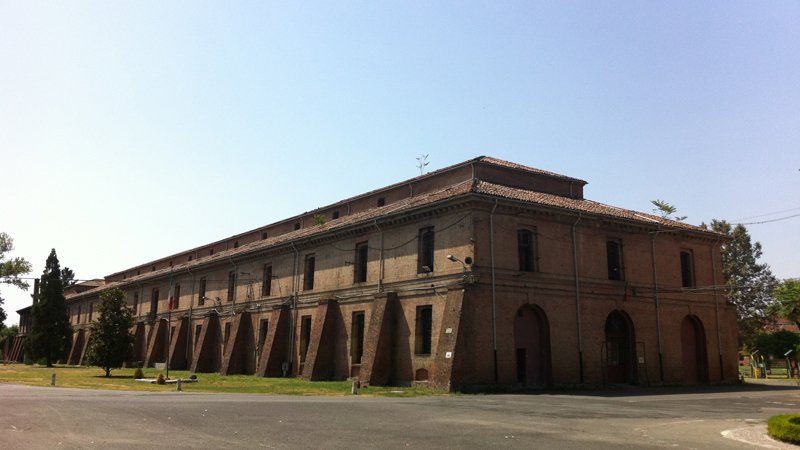
The plan is star-shaped, an irregular hexagon with its longest side parallel to the Tanaro. The six pentagonal bastions are named Sant’Antonio, Santa Cristina, San Michele, San Tommaso, San Carlo, and Beato Amedeo, linked by straight curtain walls. The defensive system is not just the wall: there are ravelins, counterguards, demi-lunes, tenailles, galleries, and casemates. The masonry is in solid bricks, with bomb-proof vaults and earthworks that absorbed impacts; the roofs are hipped, with terracotta tiles. The moat, now empty, was once flooded with water from the Tanaro. The only historic entrance was Porta Reale. The beauty lies in the geometry: each bastion protected the flanks of the others, with crossfire from three directions and no blind spots. Walking on it is the best way to understand how a modern-style fortress worked.
Piazza d’Armi and the Royal Italian Army Museum
At the heart of the fortress lies the Piazza d’Armi, about 22,000 square metres, the old parade ground. Around it stand the military buildings: the Governor’s Palace (Beleno Barracks), the San Michele Barracks, the San Carlo Barracks, the Napoleonic Armoury, the San Michele Powder Magazine, warehouses, workshops and a hospital with an infirmary. In the Beleno Barracks is the Museum of Uniforms, Weapons and Relics of the Royal Italian Army (1848-1946), opened in 2010, with about 1,500 items on display. Among the display cases is also the uniform of King Umberto II from the day he left for exile. Part of the complex still houses an Alpini barracks, with a small museum. Today the Piazza d’Armi serves as a stage for concerts, exhibitions and historical re-enactments.
The Bastion of the Tricolour and the Traces of War
The most evocative spot is the Bastion of Sant’Antonio, the highest one, where on 10 March 1821 the green, white and red tricolour flew for the first time. It was Lieutenant Colonel Guglielmo Ansaldi who raised it, and the episode is regarded as the beginning of the Piedmontese Risorgimento. The past also returns in the prisons: here the patriot Andrea Vochieri was imprisoned and, in 1867, Giuseppe Garibaldi. Later, in 1943, it was Giovannino Guareschi’s turn. During the Second World War the fortress was bombed in 1944: the marks can still be seen on the Porta del Soccorso, in the Piazza d’Armi. From up there the view sweeps over the city and the Prealps. Bring your camera, this is the right spot.
Why Visit It
First reason: it is one of the best-preserved 18th-century fortifications in Europe and the only Savoyard fortress still intact in its setting, with no modern buildings encroaching on its moats. Second: the Museum of the Royal Italian Army, with uniforms, weapons and relics from 1848 to 1946, is a time machine few would expect in a provincial town. Third: entry is free, and on a single walk you go from the bastions to the galleries, from the parade ground to the prisons. One practical tip: the galleries stay cool even in summer, so pack a light jacket. Some parts are clearly run-down, but that is part of the character of a place still seeking a balance between restoration and memory.
When to go
The Citadel is best enjoyed in low light. Sunrise or sunset are the most photogenic moments, especially from the San Michele Bastion, which offers a sweeping view of the entire fortress and the Tanaro River. In summer, the Piazza d’Armi comes alive with concerts and open-air theatre under the stars. In March, for the anniversary of the Italian tricolour, historical re-enactments take place: this is when the site tells its story best. In September there’s AleComics, the comic festival, which fills the barracks with cosplayers and curious visitors. In winter the wind over the moat is harsh, but the Po Valley fog on the bastions has its own charm. I’d go back on an early autumn morning, with clear air and few people around.
Around the Area
The Meier Bridge over the Tanaro is worth a walk: a single white span inaugurated in 2016, over 176 metres long, connecting the fortress to the centre of Alessandria. If military history appeals to you, broaden your route: in Spinetta Marengo there is the site of the 1800 battle, with the museum dedicated to Napoleon and Desaix, perfect as a second piece after the Citadel. Those who want to stay on Savoyard fortifications can head to Gavi, the village with its fort, another piece of the Piedmontese defensive system. Both destinations work well together: first the walls of Alessandria, then the countryside or the hills. End the day with a stroll through the city’s historic centre, among porticoes and squares.