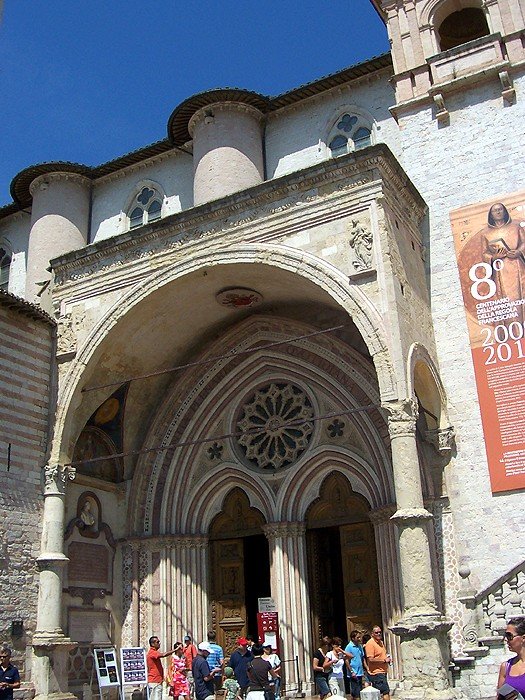
The Lower Basilica of Saint Francis in Assisi is the spiritual heart of the Franciscan complex, where the saint’s body rests. The intimate space, with ribbed vaults and 13th-14th century frescoes, offers a unique experience. Here’s what not to miss:
– Tomb of Saint Francis in the crypt, discovered in 1818;
– Frescoes by Giotto, Cimabue, and Lorenzetti in the chapels and transept;
– Romanesque-Gothic architecture in the shape of a Tau, with masterpieces like the Chapel of the Magdalene;
– Free admission and audioguide available for about 1 hour visit.
Introduction
Stepping into the Lower Basilica of Saint Francis in Assisi is like being enveloped by a silence that speaks. The filtered light, the low vaults, the scent of stone and incense: everything here is designed for contemplation. It is the heart of the Franciscan complex, the place where the saint rests and where medieval art reaches impossible heights. There’s no rush; you walk slowly, following the sloping floor toward the altar. Every corner tells a story, every fresco is a masterpiece. Giotto, Cimabue, Simone Martini: it seems impossible that they are all here, in such an intimate space. The feeling is of being inside a jewel, a place that does not merely show beauty but makes you breathe it in.
Historical Background
Construction began on July 17, 1228, the day after Saint Francis’s canonization, at the behest of Pope Gregory IX. Two years later, in 1230, the saint’s body was transferred from the Church of San Giorgio and buried here in great secrecy. The lower basilica was consecrated on May 25, 1253, by Pope Innocent IV. For centuries the tomb remained hidden until 1818, when it was rediscovered. The current crypt was built between 1925 and 1932 in Neo-Romanesque style. Meanwhile, artists like Cimabue, Giotto, and Simone Martini decorated the walls, creating one of the most important medieval painting cycles. Here are the key moments:
- 1228: construction begins
- 1230: burial of Saint Francis
- 1253: consecration of the basilica
- 1818: rediscovery of the tomb
- 1925-1932: construction of the Neo-Romanesque crypt
Frescoes and Artistic Masterpieces
The nave is a triumph of 13th-century frescoes: on the left, the Master of San Francesco paints stories of the saint, such as the Sermon to the Birds and the Stigmata. On the right, scenes of the Passion of Christ. A bit further, the Cappella della Maddalena (Magdalene Chapel) is a jewel by Giotto and his workshop (1305-1308), with the Raising of Lazarus and the Landing in Marseille. In the right transept, Cimabue’s Maestà – a Madonna and Child with angels and Saint Francis – dominates the scene with its monumentality. On the left, Pietro Lorenzetti tells the Passion with incredible pathos. And then the Chapel of Saint Martin, frescoed by Simone Martini between 1313 and 1318: a lesson in Gothic elegance. Every wall is a surprise, every time you look up you see something new.
The Tomb and the Crypt
Halfway down the nave, two flights of stairs descend into the neo-Romanesque crypt, designed by Ugo Tarchi. Here, in a stark and intimate setting, lies the body of Saint Francis. The stone sarcophagus stands at the center, protected by a grating, with his faithful companions – Brother Leo, Rufino, Masseo, and Angelo – buried at the sides. Above, a votive lamp is fueled in rotation by the Italian regions. It is a place of silence and prayer, far from the noise of the world. There is no pomp, only the simplicity willed by the saint. The staircase is the same that pilgrims have walked for centuries, and along the way you encounter the tomb of Jacopa de’ Settesoli, Francis’s Roman friend.
Why Visit It
1. See the tomb of St. Francis: it is the beating heart of Franciscanism, a pilgrimage destination from all over the world. An experience that goes beyond faith, it also touches those who are just curious. 2. Love the frescoes by Giotto, Cimabue, and Simone Martini: here medieval art reaches its peak. The pictorial cycles are among the most important in Europe, and being able to admire them up close is a privilege. 3. The intimate and evocative atmosphere: unlike the upper basilica, the lower one is intimate, almost secret. The low lights, the Romanesque vaults, the silence: everything invites you to stop and reflect.
When to Go
I recommend the early morning, right when it opens (9:00 AM Monday to Saturday). The basilica is still almost empty, the light comes in softly through the windows, and you have all the time to get lost in the frescoes. The late afternoon, around 4:00 PM, also offers a special atmosphere, with the shadows lengthening. If you can, avoid weekends and the months of July and August, when the lines get long. Autumn and spring are perfect: mild weather and fewer crowds. And if you happen to be there on October 4th, the Feast of Saint Francis, the emotion is even stronger.
Nearby
After the Lower Basilica, don’t miss the Upper Basilica just above, with Giotto’s stunning frescoes of the life of Saint Francis and Cimabue’s Stories of the Old and New Testaments. It’s another world, brighter and airier. Then, just a few steps away, there’s the Chiostro di Sisto IV, with frescoes by Dono Doni, and the Treasury Museum housing relics of the saint and a collection of medieval panels, including a Saint Francis by Fra Angelico. If you have time, climb up to the Rocca Maggiore for a breathtaking view of the Umbrian valley.