Introduction: Museo Palazzo Ricci
The Museo Palazzo Ricci in Macerata is one of those surprises you don’t expect in a city in the Marche hinterland. You enter from Via Domenico Ricci, in the historic centre, and find yourself in a noble palazzo that preserves more than three hundred works of 20th-century Italian art. It is not a dusty museum: it is a living place, where paintings converse with frescoed ceilings, period furniture and a monumental stairway in pietra cornea with Vanvitellian echoes. The collection, established in 1975 with the purchase of Ivo Pannaggi’s Treno in corsa, is now owned by the Fondazione Cassa di Risparmio della Provincia di Macerata. Here you move from Futurism to Metaphysical painting, from the Roman School to Art Informel and Pop Art, with names such as Balla, De Chirico, Morandi, Burri and Schifano. Here you walk through 20th-century Italy room by room. Admission is free, and guided tours can be booked for groups and school groups. A small great luxury for those who love art without crowds.
Historical Background
The history of
Palazzo Ricci is rooted in the heart of Macerata, in the area of the ancient Castrum Maceratae. The building, of late-sixteenth-century origin, passed to the Ricci family in the early decades of the seventeenth century: in 1601 Cardinal Petrocchini bought it and gave it to his niece Girolama on the occasion of her marriage to Antonio III Ricci. In the eighteenth century Antonio IV Ricci transformed and enlarged it; between 1764 and 1772 he had the rooms frescoed and the staircase in pietra cornea, of Vanvitellian inspiration, built. After the nineteenth-century sale and its uses during the Second World War, in 1976 the Cassa di Risparmio della Provincia di Macerata purchased the palace. A five-year restoration brought back the frescoes and furnishings. The collection had begun in 1975 with Treno in corsa by Ivo Pannaggi; the museum opened to the public in 2010. Today it is the seat of the Fondazione Carima.
- 1601: purchased by Petrocchini and the Ricci marriage.
- 1764-1772: transformation commissioned by Antonio IV.
- 1975: the collection is founded with Pannaggi.
- 1976: Carima purchases the palace.
- 2010: the museum opens.
A Textbook Twentieth Century
The collection of the Palazzo Ricci Museum is a veritable atlas of twentieth-century Italian art. It begins with Futurism, featuring Boccioni, Severini, Balla, Depero, Prampolini, and Ivo Pannaggi from Macerata, represented by the painting that launched the collection: Treno in corsa (Train in Motion). Then comes Giorgio de Chirico’s Metaphysical art, with a 1950 copy of Le Muse inquietanti (The Disquieting Muses). The Roman School is represented by Scipione, Mafai, and Antonietta Raphaël; Scipione’s La Piovra (The Octopus), from 1929, can be admired here. The route passes through the Novecento group, Corrente, abstraction, and the Art Informel of Burri and Fontana, all the way to Italian Pop Art with Schifano, Festa, and Ceroli. Morandi, Guttuso, Pirandello, Soffici, and Medardo Rosso with Ecce Puer are also present. Sculptures complete the picture: Martini, Fazzini, Basaldella, Cascella, Manzù, Mastroianni, Minguzzi, and the Pomodoro brothers. More than three hundred works, thoughtfully arranged, tell the story of an entire century. There is also a section devoted to design and furnishings, surprising in its variety.
The Palace Inside the Museum
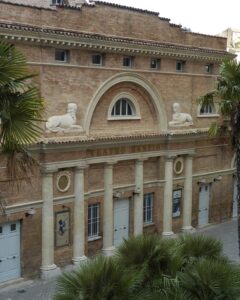
You don’t come here just for the paintings. Palazzo Ricci is a work of art in itself, with four floors linked by a hard limestone staircase in the Vanvitellian style. On the piano nobile, the Salone delle feste (Ballroom) and several other rooms preserve a cycle of frescoes inspired by Ovid’s Metamorphoses, created between the late 18th and early 19th centuries by artists from the school of Pompeo Batoni, Marco Benefial, Sebastiano Conca, and followers of Carlo Maratta and Guido Reni. The furnishings range from Louis XIV to Empire style. On the third floor there is a small chapel with a panel by Vittore Crivelli, The Pietà, likely the crowning element of a dismembered polyptych. In the basements, the grottoes open up, with remains of medieval buildings; here was also the snow house (neviera), and at the entrance a grate allowed the snow to pass through. The façade, decorated with trapezoidal ashlar blocks and paired pilasters, anticipates the nobility of the interiors. A detail few notice? The coat of arms with the hedgehog and the golden rose.
Why Visit It
There are at least three reasons to include the Museo Palazzo Ricci in an itinerary in Macerata. First: the collection is one of the most complete and well-organized on 20th-century Italian art, with over three hundred works of painting and sculpture. It is not a random collection, but a journey that clarifies movements and key figures, from Futurism to Pop Art. Second: the museum is housed in a noble palace that preserves frescoes, furnishings, and a monumental staircase; the visit is therefore twofold, artistic and architectural. Third: admission is free, and guided tours can be booked for groups and school classes, even outside regular hours. In addition, there is a library, bookshop, and historical archive, useful if you want to learn more. Management is entrusted to Meridiana Snc and the Fondazione Carima. Please note: the works must not be touched, they must be kept at a distance, and backpacks must be left in the cloakroom. But these are normal rules that do not ruin the experience. Rather, they make it more orderly.
When to Go
The best time? It depends on what you’re looking for. If you love silence, aim for a quiet morning or a shoulder-season afternoon, when Macerata is calm and the rooms aren’t crowded. The light coming through the windows makes the frescoes and paintings feel warmer, especially in the late afternoon. On hot days the palazzo stays cool; in winter it’s a welcoming refuge. If you can, avoid the middle hours of public holidays, when there are always a few extra visitors. A practical note: opening hours can vary throughout the year, so it’s worth checking before you set off. Openings are often concentrated at the weekend, with closure on Mondays. If you choose a rainy day, that’s no problem—in fact, the museum is perfect for spending a few hours indoors among art and architecture. And if you find the room empty, pause in front of Treno in corsa: it deserves a few extra minutes.
Nearby
If Museo Palazzo Ricci has whetted your appetite for art, Macerata’s city center offers two more places to pair it with. The first is Palazzo Buonaccorsi, home to the Musei Civici: here you’ll find the ticket office and a route that pairs beautifully with the 20th-century collection. The second is the Arena Sferisterio, the imposing neoclassical amphitheatre that hosts performances and festivals in summer. There is also a Biglietto Unico Macerata Musei that includes Palazzo Buonaccorsi, the Arena Sferisterio and, as an option, either Palazzo Ricci or the City Tour: a practical way to make the most of your visit. For those who want to stay on theme, a stroll through the historic centre among piazzas and noble palaces rounds off the day. No need to rush: Macerata is compact and easy to explore on foot. And after so much 20th century, a stop at a café in the centre is just the thing. The City Tour is the alternative for those who want to get their bearings in the city. In short, art and strolling combine without stress.