Introduction: The Castle of Redondesco
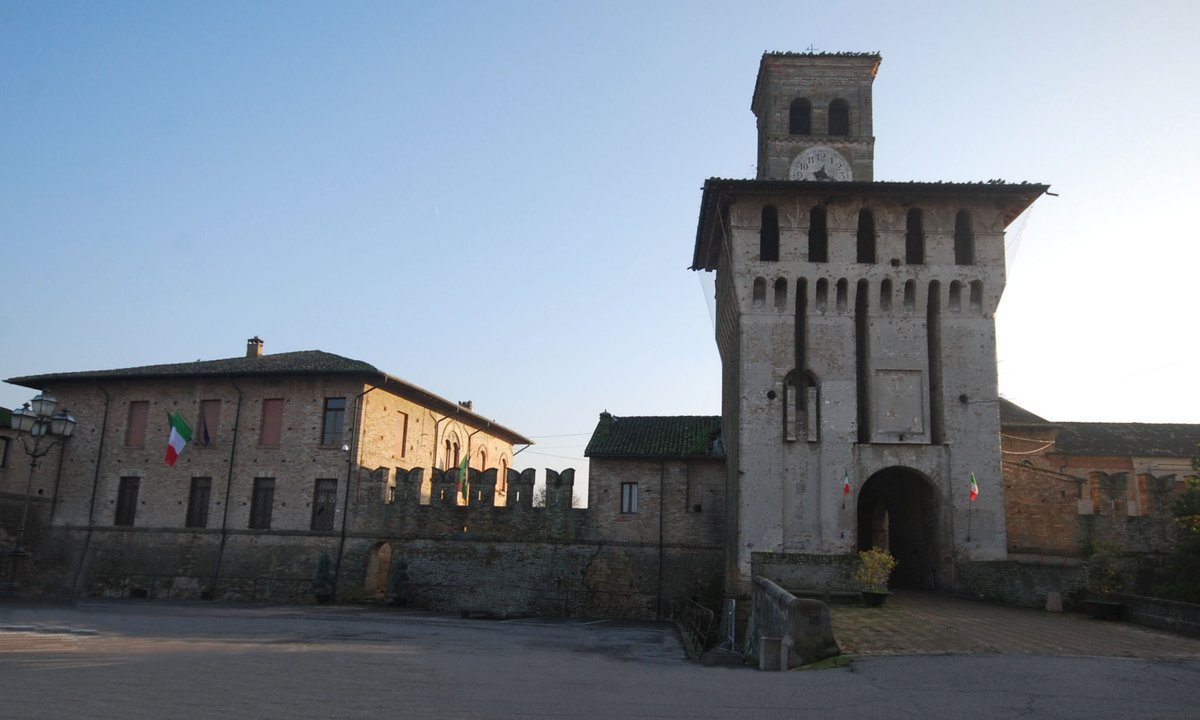
Walking around Redondesco, in the province of Mantua, you come across a silhouette rising among the houses: the Castle of Redondesco. It is not an imposing fortress, but a cluster of surviving towers that tell centuries of history. The entrance tower, quadrangular and massive, and the bell tower are all that remains of a defensive system created to control the Via Postumia. You arrive on foot, look up, and immediately realize that the Middle Ages are still alive here. Entrance is free, and the visit offers an authentic perspective, far from the big tourist circuits. A place you don’t expect, capable of surprising with its simplicity.
Historical Background
The history begins in the 12th century, when Frederick Barbarossa granted the area to the counts of Redondesco. The first structures were expanded between the 14th and 15th centuries, also thanks to the Sforza. In 1240, the castle passed to the Gonzaga, who turned it into a strategic outpost on the Postumia road. In the 17th century, the fortress was dismantled: the entrance tower and the bell tower remained standing. After the restorations in the 1970s and the intervention in 2013, following the 2012 earthquake, the castle is open to visitors again. A long history, with many changes of hands, but always linked to the control of the territory.
- 12th century: grant by Frederick Barbarossa
- 1240: transfer to the Gonzaga
- 14th-15th century: expansions under the Sforza and Gonzaga
- 17th century: dismantling and survival of the two towers
- 20th-21st century: restorations and reopening
The Two Towers: What to See
There are two protagonists. The entrance tower, quadrangular, has a brick-and-stone base and still retains its battlements. Under the Gonzagas, the lower section, the ravelin, and a stretch of the walls were added. The second tower, lower and wider, served as an outer tower: it had a double entrance, with an arched doorway, a drawbridge, and a postern gate that is now walled up. Climbing the internal staircases, you can notice the frescoes and the various construction layers. The main tower, frescoed in the 14th century, was later raised to accommodate the bell chamber. From the top, the view over the entire village is the final reward.
On the Postumian Way
Redondesco originated in Roman times as a station on the Postumian Way, an ancient route. The castle, with its strategic position and water canals, served to control that path. Walking around the walls, you can feel the atmosphere of a fortified village: narrow streets, fields, silence. The whole resembles the Castle of San Giorgio in Mantua, but in a more intimate and compact version. Perhaps it is precisely this reduced scale that makes it special: you don’t need a great monument to feel the weight of history. Two towers, a stretch of wall, and the memory of those who passed by are enough.
Why Visit It
The Castle of Redondesco deserves a visit for at least three reasons. First: admission is free, so you can stop by without commitment or haste. Second: you’ll discover rare details like the remains of the drawbridge and the seats of the bolzoni, which tell how a real fortress worked. Third: its location along the Via Postumia and its proximity to the Hermitage of San Pietro and the Church of San Maurizio turn the visit into a mini itinerary between the Middle Ages and the Renaissance. In short, it’s the kind of place that leaves a mark without needing to spend or queue.
When to Go
When’s the best time? Late afternoon, when the low sun sets the entrance tower’s bricks alight and the village starts to doze. Then autumn is ideal: during the FAI Days the castle opens for guided tours, and a spring morning can be just as moving. I’d skip the middle of summer, when the sun is high and the shadows aren’t as intriguing. And since it’s off the beaten path, you’ll often have the place almost to yourself.
In the Surroundings
It’s worth extending your walk as far as the Romitorio di San Pietro, a little Romanesque jewel with 15th-century frescoes. Just beyond, the Church of San Maurizio, which has Canossian origins, houses Renaissance frescoes of the Mantegna school, an 18th-century wooden choir, and neo-Gothic additions. These two stops complete the picture of a landscape steeped in history, where every stone has a story to tell. Ideal for anyone who loves uncovering the hidden gems of the countryside.