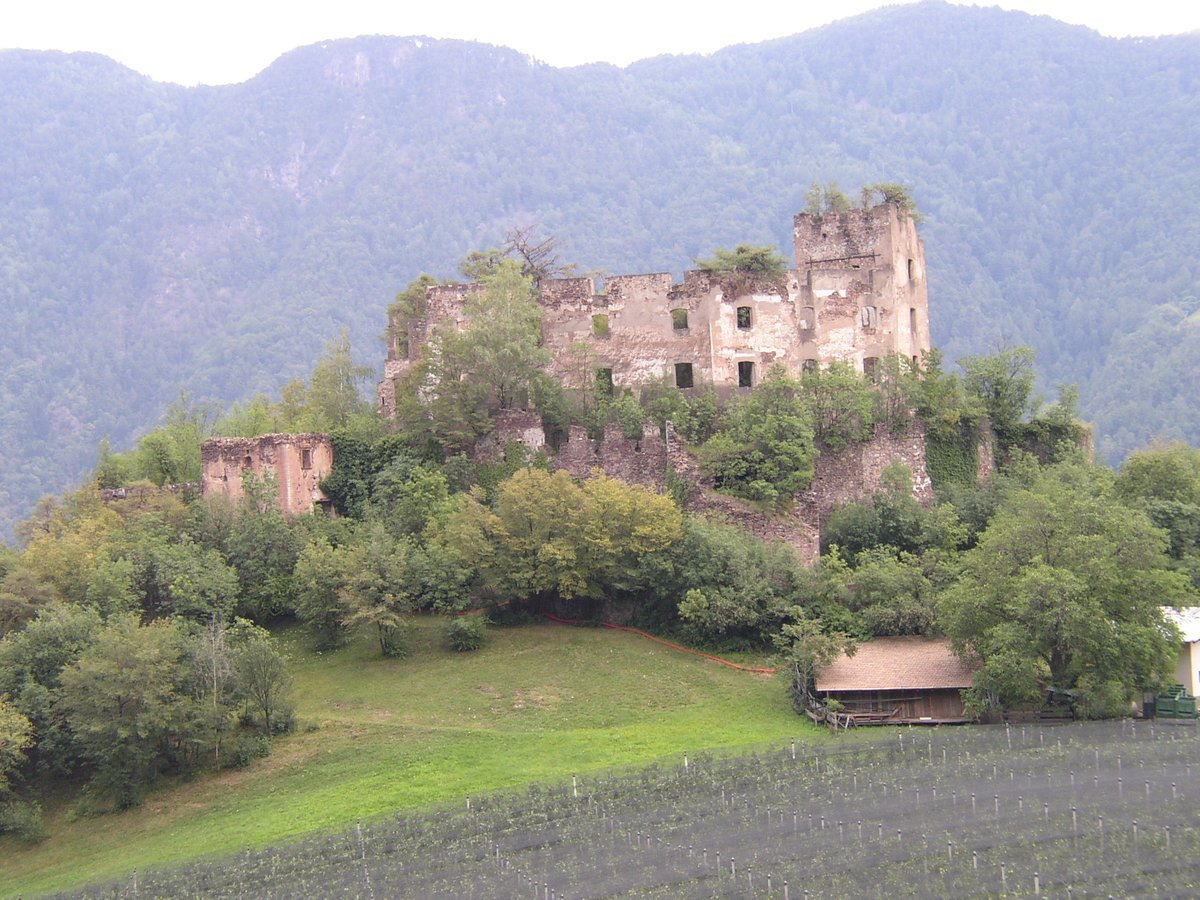
Rafenstein Castle is an imposing ruin that dominates Bolzano from high above the Talvera Gorge. Built in the 13th century to control trade routes, it is now reached via a challenging yet rewarding climb. The panorama of the city and the Sarentino Valley makes every effort worthwhile.
History: constructed by Federico Vanga, rebuilt in the 1300s, and once home to Marx Sittich.
Visiting: by request only, for groups of at least 20 people with a guide.
Access: on foot from the San Genesio cable car, with inclines up to 33%.
Surroundings: the Rafenstein Gasthaus serves South Tyrolean cuisine and autumn Törggelen.
Introduction: A Ruin Overlooking Bolzano
Castel Rafenstein is one of those places you don’t expect. Perched on the rock above the Talvera gorge, at the entrance to the Val Sarentino, it dominates Bolzano from an altitude of 692 meters. You notice it from afar: a dark, broken silhouette, with walls that seem to merge with the sky. Then you start climbing and fatigue turns into wonder. The view that opens onto the city and the valley is something you’ll hardly forget. The stones are real, blackened by time, full of cracks and climbing plants. It’s not a renovated and polished castle, but an authentic ruin, with that melancholic charm that only ruins can give. And if you’re lucky, you might have the place almost all to yourself: access is by request and visits are guided.
Historical Notes: Ravens, Bishops, and a Battle
The history of Castel Rafenstein begins in the 13th century at the behest of the Bishop of Trento, Federico Vanga, who had it built to control the trade routes between north and south. In 1277, Count Mainardo II of Tyrol destroyed it. The reconstruction, led by Ludovico of Brandenburg, began around the mid-14th century and continued for decades. The castle then passed to the von Rafenstein, von Goldegg, Weineck, and finally to the counts of Wolkenstein. It was here, around 1600, that Marx Sittich von Wolkenstein wrote his famous ‘Landesbeschreibung von Tirol’. In 1797, during the Napoleonic wars, a violent clash between French, Austrians, and Schützen reduced it to rubble. Long abandoned, it was restored between 2009 and 2014. Here are the key moments:
What Remains: Architecture and Atmosphere
Today Castel Rafenstein is an evocative ruin, yet still imposing. One can recognize the keep, an entrance tower, part of the curtain wall, and the south wing, added in the 14th century. In the 16th century the castle was reinforced with a stronghold and a circular bastion, becoming a small fortress. However, the interior cannot be visited for safety reasons. Talking with the guides (if you manage to arrange a visit) you get a sense of what life must have been like here: dark, cold, with the wind whistling among the stones. The atmosphere is truly unique. Vegetation has taken over: shrubs and wildflowers peek out between the battlements, while the contrast with the dark rock creates an almost Nordic landscape. Anyone who has come all the way up here, however, is rewarded with a view that stretches from Bolzano to the Sarntal Valley.
How to get there: a climb for trained legs
Reaching Rafenstein Castle is already an adventure. The most direct way is by car along provincial road 99 from Bolzano towards San Genesio, but the roadway is narrow and steep. Those who prefer public transport can take bus 156S. But the real experience is on foot: you start from the valley station of the San Genesio cable car and climb up an asphalted road with gradients of up to 25-33%. Don’t be too confident: even the fittest will feel their legs burn. The route is part of the ‘Castle Trail’ (Castelronda) and along the climb you can already see Castel Roncolo and the churches of San Giacomo and San Giorgio. Alternatively, cyclists know this ascent well: 2.5 km with an average gradient of 17.7%, one of the hardest in the area. Not for everyone, but the view from above is a memorable reward.
Why Visit It
At least three good reasons to come all the way up here. First: the view. From Rafenstein Castle you dominate the entire Bolzano basin and the Sarentino Valley, with a perspective you won’t find at official viewpoints. Second: authenticity. There’s no ticket, souvenir shop, or fake reconstruction; just ruins, wind, and history. Third: tranquility. Since it can only be visited by request and in a group, the experience is intimate, far from the crowds. And then there’s the charm of the place: for those who love exploring medieval remains with a touch of adventure, it feels like home. If you can arrange a guided tour (with at least 20 people), corners open up that would otherwise remain hidden: it’s absolutely worth it.
When to go
The best time? Late afternoon, just before sunset. The raking light sets Rafenstein’s walls aglow, turning them golden, and the view over Bolzano becomes spectacular. In autumn, when the woods of Val Sarentino turn red and yellow, the atmosphere is almost magical. In spring, too, the clean air and flowering meadows make the climb less strenuous and more pleasant. In summer, during the hottest hours, the effort is felt more: better to avoid the full midday sun. One thing is certain: whatever time you choose, bring water and a camera. The view will reward you for everything.
In the Surroundings
After the descent (or even before, for courage), you can pair the visit with Castel Roncolo, the famous castle of chivalric tales, which you can already see during the climb. Or, if you fancy a taste of local life, stop at Gasthaus Rafenstein: the terrace overlooking Bolzano is perfect for a break, and in autumn it already offers Törggelen with new wine and chestnuts. If you’d rather walk, the trails that climb from Bolzano’s center (like the Rafenstein loop or via Guntschna) are a great way to experience the mountains and make it up here under your own steam.