Chimera of Arezzo: 4th Century BC Etruscan Bronze at the Archaeological Museum

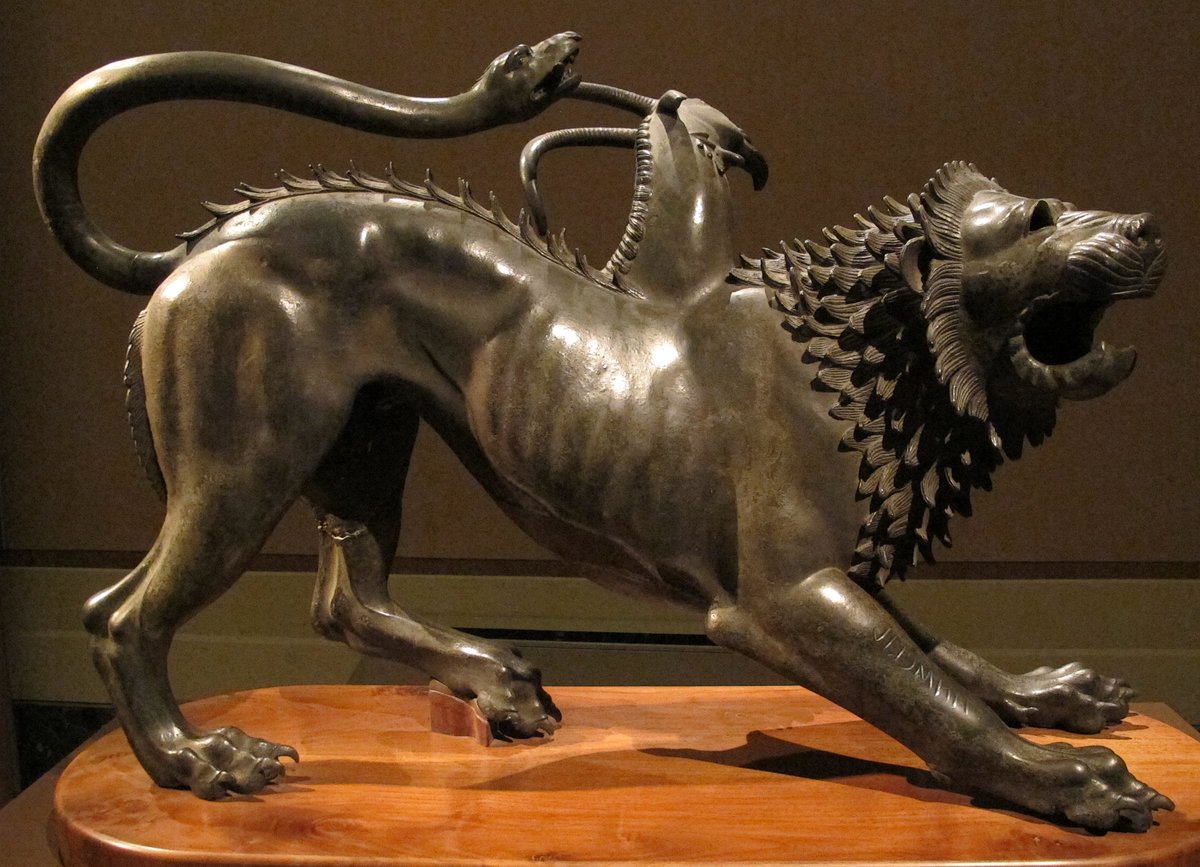
The Chimera of Arezzo is a 4th century BC Etruscan bronze representing the mythological creature with a lion’s head, goat’s body, and serpent’s tail. Discovered in 1553 during construction work, it is now the centerpiece of the National Archaeological Museum Gaio Cilnio Mecenate in Arezzo, where it has been permanently housed since 2014 after centuries in Florence.

  • 4th century BC Etruscan bronze masterpiece, approximately 80 cm tall
  • Depicts the mythical Chimera in a defensive pose with extraordinary realism
  • Displayed at the National Archaeological Museum Gaio Cilnio Mecenate in Arezzo
  • Exceptional example of lost-wax casting with perfectly preserved details

Copertina itinerario Chimera of Arezzo: 4th Century BC Etruscan Bronze at the Archaeological Museum
A 4th century BC Etruscan bronze statue depicting the mythical creature, discovered in 1553 and now displayed at the National Archaeological Museum Gaio Cilnio Mecenate in Arezzo. Admire the lost-wax casting and the realism of this masterpiece.

Good to know


Introduction

The Chimera of Arezzo welcomes you to the National Archaeological Museum Gaio Cilnio Mecenate with a breathtaking grandeur. This Etruscan bronze from the 4th century BC, discovered in 1553 during the construction of a Medici fortress, represents a unique masterpiece of lost-wax casting. Its coiled posture, with the lion’s head, snake-shaped tail, and goat’s head on its back, embodies the myth of the creature defeated by Bellerophon. Observing it up close means immersing yourself in a distant era, where Etruscan art reached peaks of realism and symbolism. Its placement in the museum’s main hall, illuminated to highlight the bronze details, makes the visit an exciting and unforgettable experience for anyone who loves ancient history.

Historical Background

The Chimera of Arezzo has a fascinating history connected to Renaissance archaeological discoveries. It was discovered on November 11, 1553 during construction work for the Medici walls of Arezzo, near Porta San Lorentino. Immediately recognized as a valuable work, it was sent to Florence by order of Cosimo I de’ Medici, where it was restored by Benvenuto Cellini. Dated to the 4th century BC, it belongs to the peak period of Etruscan craftsmanship, likely created in a workshop in Arezzo, a city renowned for metalworking. The figure represents the mythological creature defeated by Bellerophon, symbolizing the triumph of good over evil, and today it has returned to its place of origin after centuries of display in Florence.

  • 4th century BC: Creation of the bronze statue
  • 1553: Discovery during construction work
  • 1554: Transfer to Florence and Cellini’s restoration
  • 2010: Permanent return to the Archaeological Museum of Arezzo

The Lost-Wax Casting Technique

What makes the Chimera extraordinary is the perfection of the lost-wax casting, a technique the Etruscans mastered like few others. The statue, standing 78 cm tall, reveals a meticulous attention to detail: the bulging veins on the lion’s neck, the scales of the serpent-tail, and the taut musculature demonstrate unparalleled craftsmanship. Upon close inspection, the casting vents used for the molten bronze are still visible on the back. The green patina covering it is not merely a sign of age but adds depth to the creature’s fierce expression. Experts emphasize that this work was cast in a single pour—an exceptional technical feat for its time, showcasing the high level achieved by Arezzo’s workshops in bronze working.

The Embodied Myth

The Chimera is not merely a bronze statue, but the physical embodiment of a myth that has captivated humanity for millennia. According to legend, this creature breathed fire and terrorized Lycia, until the hero Bellerophon, riding Pegasus, pierced it with a lead-tipped spear that melted in its fiery breath. The statue captures the moment of the mortal wound: the goat’s head on its back is tilted in an expression of agony, while the serpent on its tail attempts to bite in vain. This dynamic quality within stillness is characteristic of Etruscan art, which loved to depict action at its climax. The Chimera of Arezzo is thus a story carved in bronze, uniting technical skill and narrative, offering a window into the spirituality and imagination of the Etruscan people.

Why Visit It

Visiting the Chimera of Arezzo is worthwhile for three concrete reasons. First, it is one of the few Etruscan bronze statues that have survived intact, allowing you to admire up close the artistic mastery of this civilization. Second, its placement in the Archaeological Museum of Arezzo, located in the former monastery of San Bernardo, provides an ideal context, with artifacts that tell the story of the Etruscan and Roman city. Third, the work is an identity symbol for Arezzo, having returned to the city after centuries in Florence, and represents a fundamental piece for understanding the importance of the region in ancient artistic production. It’s not just a museum, but a journey through time that captivates both experts and the curious.

When to Go

The best time to visit the Chimera is in the early morning hours, when the museum is less crowded and the natural light filtering through the windows illuminates the bronze, highlighting its details. Avoid weekends in mid-August, when tourist traffic is at its peak and you risk missing the calm needed to fully appreciate the artwork. In autumn, with shorter days, the museum’s atmosphere becomes more intimate, perfect for a quiet and reflective experience.

In the Surroundings

Complete your visit with a stroll to the Arezzo Cathedral, just a few minutes’ walk away, where you can admire Guillaume de Marcillat’s stained glass windows and Piero della Francesca’s Mary Magdalene. For a thematic experience, head to the Roman Amphitheatre, also in the historic centre, which showcases Arezzo’s importance in Roman times and offers an interesting contrast with the Etruscan heritage of the Chimera.

💡 Did You Know…?

The Chimera was found together with small votive statuettes, likely part of a sacred deposit. A local legend tells that the discovery occurred during a thunderstorm, when a lightning bolt supposedly illuminated the exact spot where it lay buried. The 2010 restoration revealed traces of gold leaf on the mane, indicating that the statue was originally even more precious. Interestingly, the right front leg is missing, lost already in antiquity.