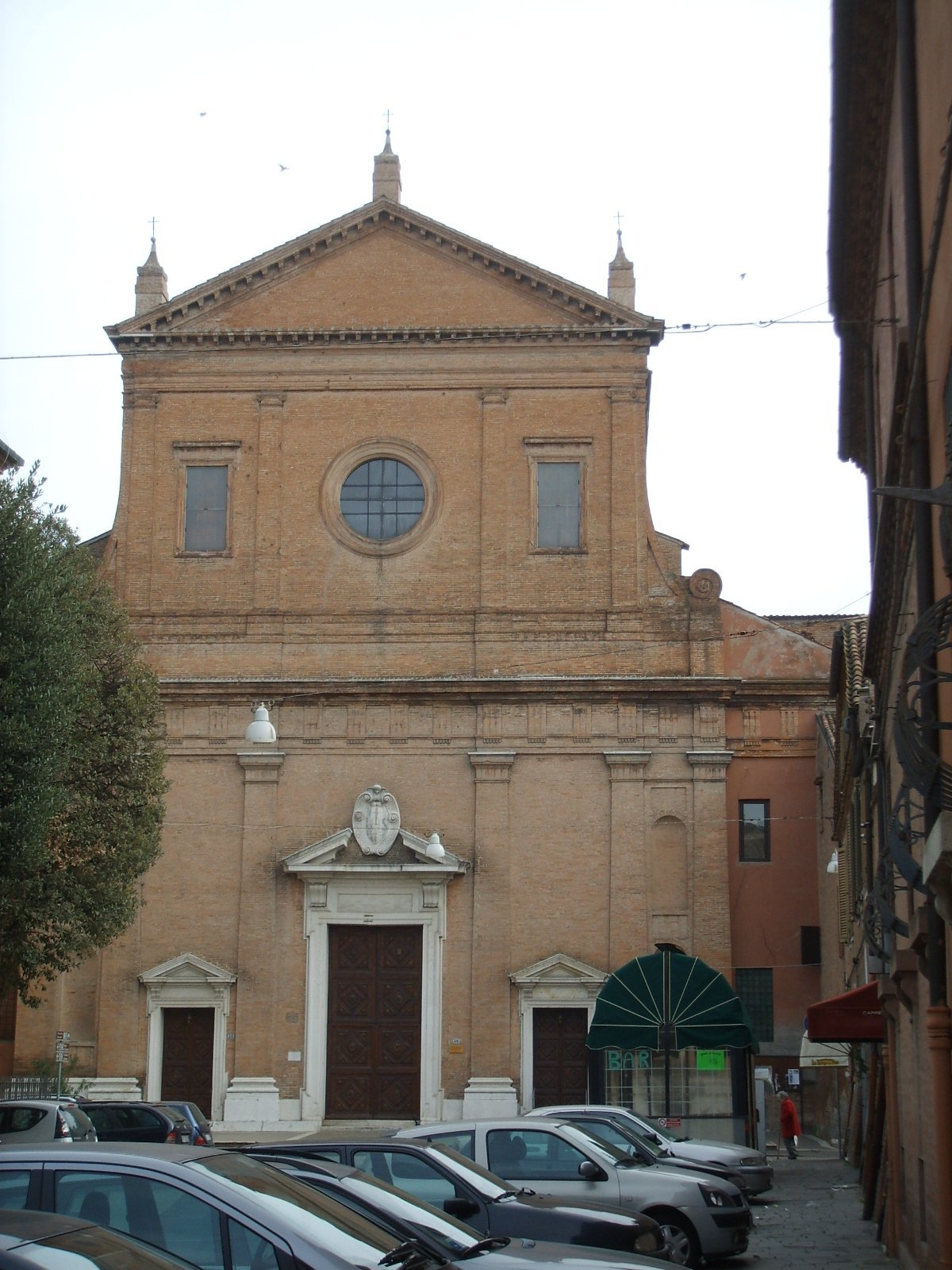
The Church of San Michele del Gesù, at Via Borgoleoni 56, is an active place of worship in the heart of Ferrara, between the Castello Estense and the Palazzo dei Diamanti. Founded in 1570 for the Jesuits and consecrated in 1599, it preserves Guido Mazzoni’s Lamentation over the Dead Christ, the monument to Barbara of Austria, and a single nave. Its sober, Renaissance brick façade houses works from the 16th to the 18th century and a history marked by the 1944 bombings. – Guido Mazzoni’s Lamentation: 15th-century polychrome terracotta. – Monument to Barbara of Austria: behind the altar, by Pirro Ligorio. – Events: lectures and concerts for San Michele. – Info: free entry, variable hours, ramp access.
Introduction: Church of San Michele del Gesù
The Church of San Michele del Gesù isn’t one of those monuments that jump out at you. It sits on Via Borgoleoni, a short walk from the Castello Estense, and from the outside it shows a sober brick facade, almost understated. Then you step inside and realize that Ferrara hides its treasures well. The building, also known as the Church of the Gesù, was built in the second half of the sixteenth century for the Jesuits, within the Addizione Erculea commissioned by Ercole I d’Este. The single nave, side chapels, and bright dome create an intimate but not heavy space. The reason it’s worth the detour, however, is Guido Mazzoni’s Lamentation over the Dead Christ: polychrome terracotta, true grief, before 1485. Add the monument to Barbara of Austria and a few works from the 16th to 18th centuries. Don’t expect the chaos of the great museums: here you breathe in a more intimate Ferrara.
Historical background
The church’s history goes back a long way. The Jesuits arrived in Ferrara in
1551, invited by Duke
Ercole II d’Este to found an educational college. The church was built in
1570 to a design by
Alberto Schiatti, with contributions from the Este dukes and private citizens. It was consecrated in
1599 by Archbishop
Giovanni Fontana. In 1773 the Society of Jesus was suppressed and the complex passed to the Somascan Fathers; after the Napoleonic suppressions, the college became a courthouse, hospital and prison. The Jesuits returned in 1847 and remained until 1979. In 1933 Archbishop Ruggero Bovelli transferred the Priory of San Michele here, giving the church its current name; in 1986 the parish was renamed Parish of the Gesù. The bombings of 1944 severely damaged the church, which lost frescoes and was restored. Timeline:
- 1551: the Jesuits arrive in Ferrara.
- 1570: construction of the church.
- 1599: consecration.
- 1773: suppression of the Jesuits.
- 1847: return of the Jesuits.
- 1933: Priory of San Michele.
- 1944: bombings.
- 1986: Parish of the Gesù.
Architecture: Brick, a Single Nave, and a Luminous Dome
From the outside, what strikes you is the red-brick façade, clean and sober, with three doorways decorated in pale marble: the central one is larger than the side ones. It is a Renaissance face that promises no excess, yet places the church within the fabric of the Addizione Erculea, the 1492 urban plan by Biagio Rossetti. Inside, the space has a single nave flanked by chapels, with a dome that brings light down onto the congregation. The inspiration is the Church of the Gesù in Rome, but here the scale remains Ferrarese: intimate, measurable, almost familiar. There are no side aisles to scatter the gaze. The chapels open along the sides and guide visitors toward the high altar, where the most important works are concentrated. The simplicity of the whole is its strength: few materials, clear lines, and light that changes with the hour. If you visit on a sunny day, the dome becomes the true beacon of the visit.
Masterpieces: Mazzoni’s Lamentation and Barbara of Austria
The piece that stays with you is the Lamentation over the Body of Christ, also known as the Pianzun dla Rosa. It is a sculptural group in polychrome terracotta by Guido Mazzoni, datable to before 1485. It comes from the church of Santa Maria della Rosa, destroyed during World War II: hence the nickname. The statues are life-size and show grief in a direct, unfiltered way. It is not a cold museum piece: it is theatrical, popular, almost noisy in its silence. Behind the high altar is the funerary monument of Barbara of Austria, wife of Alfonso II d’Este, who died in 1572. It was designed by the Neapolitan architect Pirro Ligorio. The church also preserves the Annunciation by Il Bastarolo (1585) and works by Giuseppe Maria Crespi. The mix of Renaissance, Counter-Reformation, and everyday devotion is what makes this visit different from the usual Ferrara stops.
The Church Today: Patronal Feast and Neighborhood Life
The church is not just a tourist stop: it is an active place of worship. In September 2022, the first edition of the Patronal Feast of San Michele al Gesù was held, with a program that combined culture, devotion, and conviviality. Events included lectures such as Francesco Scafuri’s ‘The Church of the Gesù, an Extraordinary Story,’ and Marialucia Menegatti’s talk on Saint Michael the Archangel between devotion and art. There was also music, including a concert by the Este Brass Quintet conducted by Gianmaria Raminelli, solemn Masses, and a procession with the statue of Saint Michael through the streets of the city center. On September 29, 2024, the church hosted a Mass for the feast of Saint Michael the Archangel, patron saint of the Italian State Police, celebrated by Archbishop Giancarlo Perego. If you happen to be there on those days, you will find a more community-minded and less touristy Ferrara: a good reason to come back.
Why visit: three concrete reasons
First: the Lamentation by Guido Mazzoni is one of those masterpieces you don’t expect in a provincial church. It is polychrome terracotta, dating from before 1485, and has a rare emotional power. Second: the church is a perfect example of Jesuit architecture in Ferrara, with a single nave, a luminous dome and a brick facade that tells the story of Biagio Rossetti’s Addizione Erculea. Third: the location. We are on Via Borgoleoni, near the Estense Castle, the Palazzo dei Diamanti and Via delle Volte. You can include it in a walk through the centre without complicated detours. What’s more, admission is free and there are ramps for wheelchairs and pushchairs. Free guided tours, when available, add context without weighing you down. It is not the largest church in Ferrara, but it is among the most surprising. And the monument to Barbara of Austria, designed by Pirro Ligorio, completes the picture.
When to go: light, silence and the patron saint festival
There’s no wrong season, but the right time depends on what you’re looking for. To enjoy the luminous dome and the nave without the crowds, aim for a morning or late afternoon, when the light comes in more softly and there are fewer groups. The church is open mainly on weekends and on some weekdays, but hours often change: it’s best to check before you set off. If you want a livelier experience, keep an eye out for the Feast of the Patron Saint San Michele al Gesù, held in September, which brings the square to life with talks, music, and processions. On those days the church becomes the heart of a community, not just a tourist destination. Avoid the central hours of Sundays with Mass if you’re seeking silence. In autumn, Ferrara is often wrapped in fog: the mood is melancholic but evocative.
Nearby: Castello Estense and Palazzo dei Diamanti
As you leave the church, you are already in the heart of Ferrara. Just a few steps away is the Castello Estense, with its moat and towers: it is the symbol of the city and a must-see. Still nearby, the Palazzo dei Diamanti with its facade of white and pink marble ashlar, home to exhibitions and an art gallery. If you enjoy walking, slip into Via delle Volte, the most atmospheric medieval street in the center, with arches and bricks that tell the story of Ferrara before the Addizione Erculea. For those who want to stay on a religious theme, the former church of San Michele Arcangelo, in Piazzetta San Michele, is one of the oldest in the city: it was suppressed in 1932 and the parish passed to the Church of Gesù. Today it is an exposed-brick building with blind arches. The loop closes with a walk toward the Cathedral and Piazza Trento e Trieste.