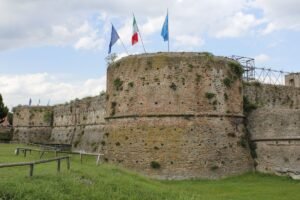
The Castle of Monticelli d’Ongina, known as the Rocca Pallavicino-Casali, is one of the most imposing lowland castles in the Piacenza area: built in brick in the 15th century by Rolando Pallavicino, it overlooks the village near the Po. Highlights include the chapel frescoed by the Bembo family, the noble halls with allegories of the seasons, the prison cells with graffiti, and the cellars housing the Aquarium and the Po River Museum. Visits are held on Sunday afternoons by reservation, with closures in January, July, August, and December.
– 15th-century fortress with cylindrical towers and a moat
– Bembo Chapel with the Last Supper and Saint George
– Po River, Peasant, Archaeological, and Civic Museums
– Events and exhibitions in the courtyard and halls
Introduction
Imagine a stretch of flat fields, the Po flowing slowly a short distance away, and suddenly a mass of red brick rising like a fortress from another era. The Castello di Monticelli d’Ongina, also known as Rocca Pallavicino-Casali, is one of the most imposing castles on the plains of Emilia-Romagna. Its four cylindrical towers at the corners, the moat surrounding it, and its entirely brick architecture make it immediately recognizable. As soon as you see it, you understand why it is considered a symbol of the Piacenza area. It is not the usual postcard castle: it is massive, stern, yet at the same time elegant in its fifteenth-century lines. The emotional impact is strong, especially if you arrive at sunset, when the sun turns the bricks red and the moat reflects the towers. A place that seems suspended between history and legend.
Historical notes
The first mention dates back to
1298, when Cremona fortified the village. The current fortress was commissioned by
Rolando Pallavicino, known as the Magnificent, and begun in
1420. His son
Carlo, bishop of Lodi, completed it and in
1456 commissioned the chapel frescoes from the Bembo family. In
1500 the fief passed to the
Casali family, who held it until
1957, when it was sold to the parish of San Lorenzo. In
2013 it won the FAI Classe Amica award and in
2020 it was the most voted in the province of Piacenza in Places of the Heart. In
2022 it was put up for sale for €950,000.
- 1298: Cremona fortifies the village.
- 1420: Rolando Pallavicino starts the fortress.
- 1456: Carlo Pallavicino, bishop of Lodi.
- c. 1460: Bembo frescoes.
- 1500: Passes to the Casali family.
- 1957: Sale to the parish.
- 2020: Most voted in the province in Places of the Heart.
- 2022: Put up for sale.
Architecture: A Brick Giant
The castle strikes you with its quadrangular plan and four cylindrical corner towers that rise above the curtain walls. Two projecting gate towers stand at the centre of the east and west fronts: here traces of the drawbridges remain, now replaced by masonry bridges. Everything is in brick, the material typical of Piacenza’s castles, and the building is considered one of the largest in the lower Po Valley. A wide moat surrounds the structure. Inside, the rectangular courtyard preserves a portico with round arches on one side only. The noble apartments on the first floor are reached by a stone staircase and retain eighteenth-century decorations, frescoed ceilings with allegories of the seasons, and a large fresco depicting the triumph of the Casali. Narrow spiral staircases lead to the patrol walkways on the curtain walls, with swallowtail merlons. In the cellars, once stables and storehouses, are the museums.
The Bembo Chapel: A 15th-Century Treasure
The Court Chapel, located on the first floor of the western keep, is a jewel discovered only in 1967. Here Bonifacio and Benedetto Bembo, Cremonese painters, created around 1460 a cycle of frescoes using the green earth technique, which allowed large surfaces to be decorated quickly and economically. The subjects are drawn from the Gospels and the life of Saint Bassianus of Lodi, patron saint of the city where Carlo Pallavicino was bishop. One can recognize a Saint George Slaying the Dragon, a Madonna with Saints Bernardino of Siena and Bernard of Clairvaux, the Calvary, the Annunciation, the Deposition, the four Evangelists and a portrait of Carlo Pallavicino. There is also a Last Supper that, according to the critic Vittorio Sgarbi, may have inspired Leonardo da Vinci’s famous Last Supper in Milan. An evocative setting, where time seems to have stood still.
The Museums of the Po and Life in the Cellars
The castle’s cellars, once stables and storerooms, now house a fascinating museum complex dedicated to the Po River. Here you will find the Ethnographic Museum of the Po, the Po Aquarium, the Archaeological Museum, and the Museum of Peasant and Artisan Culture. On the ground floor, in rooms reached from the portico, there is also the Civic Museum. The highlight of the ethnographic museum is a dugout canoe, carved from a single tree trunk and dated between the second half of the 6th century and the first decades of the 7th century AD. It is a find that bears witness to life along the river in Lombard times. In the cellars, too, you can soak up an authentic atmosphere amid farm tools, vintage photographs, and reconstructions. And then there is the legend: it is said that the ghost of Giuseppina, a young woman murdered in 1872 by a rejected suitor, makes herself known through laments coming from the walls of the fortress. A touch of mystery that fascinates adults and children alike.
Why you should visit
If you love castles, this is one not to be missed. First reason: the architecture. It is one of the most imposing plain castles in Emilia-Romagna, entirely in brick, with towers, a moat and walkways that tell centuries of history. Second: Bembo’s frescoes. The 15th-century chapel is a rare example of green earth painting, with a Last Supper that may have inspired Leonardo. Third: the Po museums. A chance to discover life along the river, with finds such as the Lombard dugout canoe and the aquarium. Moreover, the castle is open every Sunday (with winter hours 2:30–5:00 pm and summer hours 3:00–6:30 pm), although it is closed in January, July, August and December. Visits are by reservation, so plan your trip in advance. And if you like ghost stories, ask about the legend of Giuseppina. A place that combines art, history and nature all at once.
When to Go
There’s no perfect time for everyone, but if I can offer one piece of advice, aim for a Sunday afternoon in late spring or autumn, when the light is soft and the weather is pleasant. In summer, when it’s hot, the cellars and museums offer a welcome cool escape, but the towers can be stifling. Autumn, with the mists rising from the Po, gives the castle a mysterious, romantic atmosphere—perfect for the legend of Giuseppina. Winter has its own charm too, but remember that the castle is closed in January and December. Avoid July and August, not only because of the heat but because it is closed. Spring, with the fields turning green and flowers blooming along the moat, is perhaps the best time of all. In any case, always check opening hours and book ahead, because visits are by appointment only. And if you can, go at sunset: the sky reflected in the moat is a sight to behold.
Around the Area
After visiting the castle, treat yourself to a walk through the village of Monticelli d’Ongina. Here you’ll find the Collegiate Church of San Lorenzo, the main church, and along the main street you can’t miss the garlic monument, a tribute to the local specialty. If you love nature, head to Isola Serafini, a natural area on the Po, a site of community importance, ideal for birdwatching and sports such as kayaking. The Po River is the true star of this area: you can cycle or walk along its banks, enjoying the riverside landscape. For those who want to delve into rural culture, the Ethnographic Museum of the Po is already inside the castle, but in the surrounding area there are also farms and farm stays where you can taste typical products such as Monticelli garlic. A perfect way to end the day relaxing.