
Alessandria is one of those cities that surprises: seemingly sleepy, it hides a historic center full of surprises. This 1-day walking itinerary guides you through 6 selected stops to discover the heart of the city, from the Citadel (one of the largest fortresses in Europe) to the Arch of Triumph, passing by Liberty-style palaces and elegant squares. It includes a detailed map so you don’t miss any corner. Perfect for those who love walking and want an experience away from crowded tourist circuits. Alessandria’s historic center awaits you: just one day and comfortable shoes are enough.
🗺️ Your trip at a glance
A compact but complete itinerary, ideal for a day discovering Alessandria. Here’s why it works:
- Ideal for: city breakers and history enthusiasts who want a leisurely walking route.
- Strong points: 6 stops off the beaten path, with map for orientation and plenty of architectural details.
- For whom: travelers who want to discover Alessandria in one day, with a mix of monuments and hidden corners.
Itinerary stops
Stop no. 1
Citadel of Alessandria: The Star Fortress
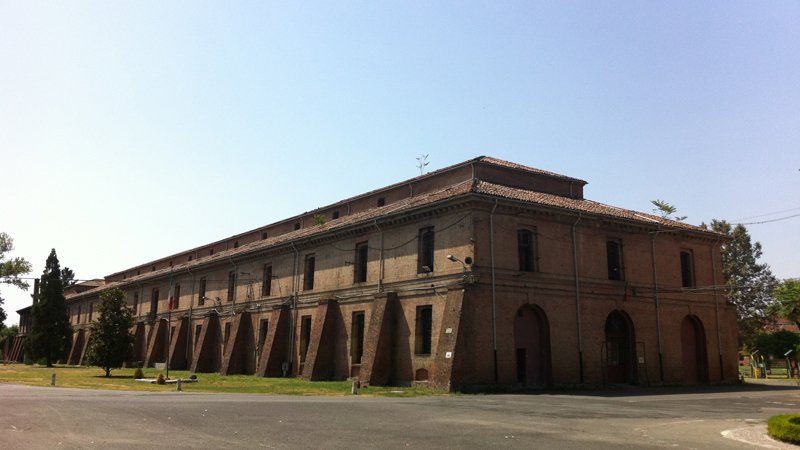 The first stop on this itinerary takes you just outside the city center, across the Tanaro River, where the Citadel stands. This is no ordinary fortress: it is the only lowland fortress built by the Savoys in the 18th century, and still one of the best preserved in Europe. Entering means walking through 60 hectares of history: six pentagonal bastions, moats once flooded with river water, and miles of bomb-proof underground galleries. Here, on March 10, 1821, the Italian Tricolor was raised for the first time—an episode that speaks volumes about its role in the Risorgimento. Strolling across the Parade Ground—about 22,000 m²—you feel small against the mighty brick walls, yet the atmosphere is relaxed, with a few trees and benches to rest on. Admission is free, and there are often exhibitions or events—maybe AleComics, the comic book festival. If you feel like it, climb up to Bastion Sant’Antonio: the view over the city and the Prealps is your reward.
- Lungo Tanaro San Martino, Alessandria (AL)
- Open in Google Maps
- View on Google Images

You should go if…
Those who choose the Citadel are not looking for the usual postcard itinerary: they are curious travelers, passionate about fortifications and border stories, who can be moved by a bastion carved by time.
Citadel of Alessandria
Stop no. 2
Rodolfo Gambini: The Painter Who Adorned Alessandria
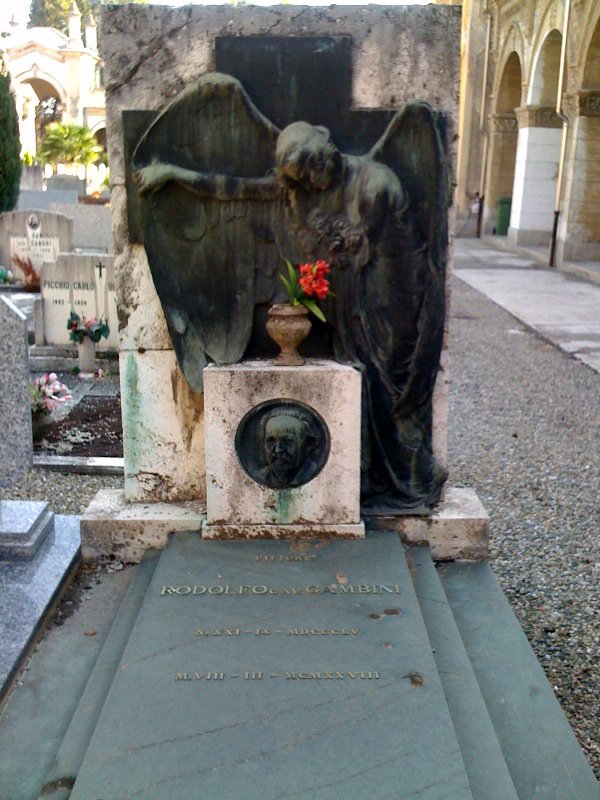 Rodolfo Gambini (1855-1928) was a painter and decorator trained at the Brera Academy, specializing in floral motifs in gouache and fresco. In Alessandria he left a deep mark: he decorated the railway station, the San Paolo Bank, and many sacred buildings. His workshop was very active, and much of his archive was lost in the bombings of 1945. Today, walking along Viale Teresa Michel, you can breathe the atmosphere of an artist who managed to combine Art Nouveau elegance and religious tradition, leaving works scattered throughout the city and its surroundings.
- Viale Teresa Michel, Alessandria (AL)
- Open in Google Maps
- View on Google Images
You should go if…
Visitors to this stop are art enthusiasts seeking the traces of a forgotten painter of Piedmontese Art Nouveau, capable of transforming churches and palaces into small jewels.
Rodolfo Gambini
Stop no. 3
Triumphal Arch
 It may seem odd, but the Triumphal Arch of Alessandria – also known as the Arch of Marengo – now sits in the middle of a traffic circle. Built in 1768 by architect Giuseppe Caselli to celebrate the visit of Vittorio Amedeo III and Maria Antonia Ferdinanda, it is a rare example of an 18th-century triumphal arch, since most date from the 1800s. Constructed of brick with a stucco finish that mimics brick, it has a single archway and two orders: Doric pilasters, a broken pediment, and above, an attic with ornamental vases. Restored multiple times (1843, 1879, 1968, and most recently in 2022), it now stands in Piazza Matteotti, forming a backdrop to Via Dante. If you pass by, stop to read the inscriptions: on one side, the original Latin epigraph; on the other, the plaque from the 1968 restoration featuring the city’s coat of arms. It’s not just a monument: its silhouette also appears in the logo of Alessandria Calcio. A piece of history standing firm amid the traffic.
- Piazza Giacomo Matteotti, Alessandria (AL)
- Open in Google Maps
- View on Google Images
You should go if…
Those who visit this stop are curious about history and architecture, drawn to unusual and underappreciated monuments, and able to appreciate the charm of an unexpected baroque arch in a modern roundabout.
Triumphal Arch
Stop no. 4
Palatium Vetus, the Medieval Heart of Alessandria
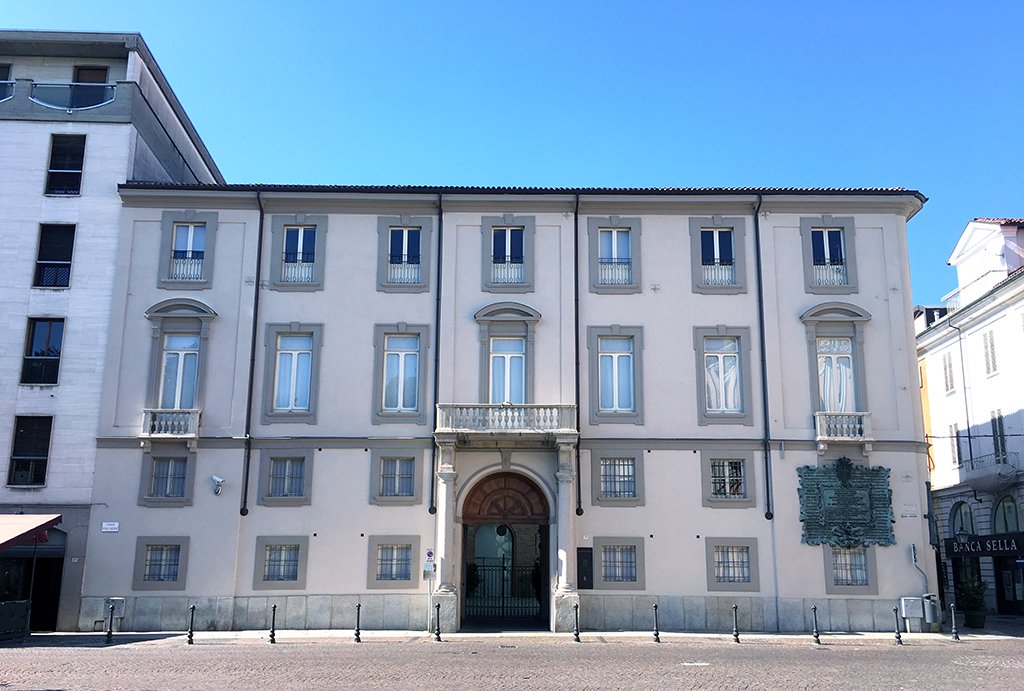 After the Arch of Triumph, the Palatium Vetus awaits you, the oldest public building in the city. We are in Piazza della Libertà, and here the Middle Ages come back to life. Built between the 12th and 13th centuries as a broletto – that is, the seat of the municipal government – it has seen Spanish governors, the Savoy, and Napoleonic prefects pass through. Then, until 1995, it served as a military district. Fortunately, the Fondazione Cassa di Risparmio di Alessandria restored it (with architect Gae Aulenti) and reopened it in 2012. The Lombard-style façade preserves plaques and a cannon from the “Hundred Cannons” donated to the city. Inside, the frescoed hall is a marvel: 13th-century coats of arms, a 14th-century Saint Paul, and a resurrection that seems almost abstract. The Foundation’s art collection ranges from Pellizza da Volpedo to Carrà. The inner courtyard, covered with glass and steel, is a perfect blend of ancient and modern. Entry is free, but the frescoed hall can only be seen on a guided tour (Saturday and Sunday). It is worth booking ahead: the atmosphere is that of a secret place.
You should go if…
Those who come here are explorers of historical layers, drawn by medieval frescoes and art collections, seeking the discreet charm of a lesser-known palace rich with stories.
Palatium Vetus
Stop no. 5
Piazza della Libertà: Alessandria’s Living Room
 After leaving the Palatium Vetus, you step into Piazza della Libertà, the city’s true living room. Here once stood the ancient cathedral of San Pietro, demolished by order of Napoleon in 1803 to create this vast space. Today, the square is a blend of eras: dominating the scene is Palazzo Ghilini, a Baroque masterpiece with an octagonal staircase and frescoes by Cucchi; next to it, the rationalist Post Office Building (1939-41) boasts a 38-meter-long mosaic by Gino Severini. On the other side, the Municipal Palace, nicknamed “Red,” and its rooster symbolizing victory over the Casalesi. At the center stands the statue of Urbano Rattazzi (the current one dates from 1943, replacing an earlier version). The square is also about life: the weekly market, the cafés, and recent traffic restrictions (from 2026) are making it increasingly pedestrian-friendly, perfect for a break. Curious fact: beneath your feet, just a few meters down, lie the foundations of the ancient cathedral.
- Alessandria (AL)
- Open in Google Maps
- View on Google Images
You should go if…
Those who visit Piazza della Libertà love its layered history and vibrant life: a curious traveler who stops to admire the buildings but also to soak in the atmosphere of the market and cafés.
Piazza della Libertà
Stop no. 6
San Francesco Convent Complex
 Close your itinerary with an unusual stop: the former convent of San Francesco, which at first glance looks like a construction site, but is actually a treasure chest of history. In 1213, Saint Francis himself passed through here and – after centuries of religious life – in 1802 Napoleon turned it into a barracks, then in 1833 Charles Albert converted it into a military hospital, a function it served until 1989. Today, thanks to PNRR and POR FESR funds, it is being reborn: the Gothic church with three naves, cross vaults and exposed brickwork, will become the new civic museum, while the convent will house university accommodations and public spaces. Enter (if the construction site allows) and look up: at the surviving 14th-century frescoes, like the fleur-de-lis on the keystone, a memory of the Angevin contribution. A place that speaks of layers, between sacred and military, and that will soon come back to life.
- Via Ventiquattro Maggio, Alessandria (AL)
- Open in Google Maps
- View on Google Images
You should go if…
The traveler who arrives here seeks the authenticity of restoration: not a polished monument, but a place in transformation, where past and future touch.
San Francesco Convent Complex


