Ferento is an archaeological site about 7 km from Viterbo, along the Strada Teverina. The ancient Roman city, founded after the abandonment of Acquarossa, preserves a theatre, baths, and the decumanus of the via Ferentiensis. Destroyed in 1172, today it offers guided tours and the Ferento Teatro Festival.
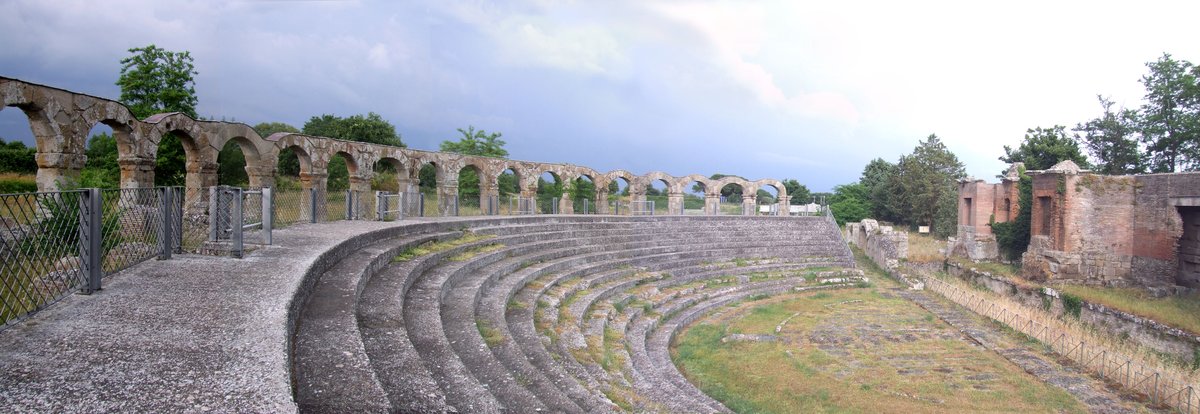
– Roman theatre: a 60 m cavea, 3,000 spectators, and statues of the Muses at the Viterbo Museum.
– Baths: black-and-white mosaics, frigidarium, tepidarium, and calidarium.
– Decumanus Maximus: a 3.60 m wide basalt-paved street, the heart of the Roman city.
– Ferento Teatro Festival: summer performances in the ancient theatre.
Ferento: Roman Theatre and Etruscan History
Ferento is not your usual postcard archaeological site. You arrive on Strada Teverina, leave your car, and before you lies a tufa plateau of about 30 hectares, suspended between the Vezzarella and Acquarossa streams. Here ancient Ferentium reached its greatest splendour in the Augustan age: a theatre, baths, forum, domus, and a basalt-paved road that cut through the city. Then, in 1172, Viterbo destroyed it, and silence took over. Walking among the ruins is a physical experience: the tufa is porous, the sun beats down, lizards dart across the blocks. The Roman theatre, however, is still there, with its peperino arches and a cavea that seems to drink in the light. And in summer, when the festival lights up the stage, Ferento speaks again. Don’t expect a crowded Pompeii: here the beauty lies precisely in the contrast between ancient grandeur and the Viterbo countryside.
Historical background: from Acquarossa to the destruction of 1172
Ferento, Lat. Ferentium, stands on the hill of Pianicara. Before it stood Acquarossa, an Etruscan settlement destroyed at the end of the 6th century BC; the survivors moved here.
Between the 4th and 3rd centuries BC the Roman urban centre came into being; in the Augustan age it reached its greatest splendour with a theatre, forum, baths and amphitheatre. In the 2nd century AD it was called civitas splendidissima. It was the birthplace of Otho and Flavia Domitilla. In the Middle Ages it was a bishopric and commune; in 1170 Viterbo attacked it and
in 1172 destroyed it. Here are the key moments:
- 9th century BC: first settlements
- 6th century BC: destruction of Acquarossa
- 4th-3rd century BC: Roman centre
- 1st century AD: greatest splendour
- 2nd century AD: civitas splendidissima
- 1172: destruction by Viterbo
The Roman Theatre: Cavea, Arches and Muses
The theatre is the highlight. Built in the 1st century AD and restored in the 2nd, it had a cavea partly carved into the tufa and a capacity of about 3,000 spectators. Today you can see 27 external arches made of peperino blocks, the steps and the orchestra of over 20 metres. The frons scaenae preserves seven visible doorways and traces of its sculptural decoration: statues of the Muses and the Pothos by Skopas are in the National Etruscan Museum of Viterbo. In summer the theatre comes alive again with the Ferento Teatro Festival: concerts, drama and tributes, such as the one to Franco Battiato. Sitting there at sunset, as the countryside darkens, is an entirely different experience from a daytime visit. The arches are not just ruins: they are natural stage wings. Wear comfortable shoes; the area is large and uneven.
Baths, Decumanus and Domus: Everyday Life in Ferento
Ferento is more than just a theatre. To the east are the public baths of the 1st century AD, with a frigidarium, tepidarium and calidarium, geometric black-and-white mosaics and tubuli for heating. Some rooms had entrances directly off the decumanus. And then there is the decumanus maximus, a basalt-paved street 3.60 metres wide, the urban stretch of the Via Ferentiensis that linked the Cassia to the Tiber. Along the axis you can identify tabernae, stone thresholds and column bases. West of the theatre stands a domus with a Tuscan atrium with impluvium and cubicula, dating from the late Republican period and then Julio-Claudian. Beside it, a public cistern with three communicating chambers in opus mixtum. Walking here, you understand that Ferento was a real city, not an isolated sanctuary: it traded, bathed, drank and built.
Acquarossa and the Necropolises: Before and After Ferento
Near Ferento lies another piece of the puzzle: Acquarossa, on the hill of San Francesco. Here the excavations of the Swedish Institute, begun in 1966 under the patronage of King Gustav VI Adolf, have brought to light the foundations of Etruscan houses, a political-religious complex, and the transition from hut to stone house. The city was destroyed at the end of the 6th century BC, and over its 32 hectares no further building took place: this is why the remains have been preserved. Around Ferento you also come across necropolises such as Procoietto, Poggio della Lupa, and Poggio della Lestra. At Poggio della Lupa is the Tomba dei Salvi, the family tomb of Emperor Otho; a short distance away is the Ferento Mine, a gallery of about 50 metres for the extraction of limonite. These are details that make the landscape an open-air archive.
Why visit: three concrete reasons
First: the Roman theatre is among the best preserved in Lazio and in summer it hosts performances, so it is not a dead monument. Second: the site is vast and uncrowded; you can wander among the decumanus, baths and domus without the crowds, with a direct connection to the ruins. Third: you can understand the history of the area, from the Etruscan world of Acquarossa to Roman Ferentium up to the destruction of 1172, all on a single plateau. What’s more, admission is by donation and the site is run by Archeotuscia, which organises guided tours. This is not a quick in-and-out visit: better to take your time, read the panels and let yourself be surprised by the views over the streams. If you love archaeology but can’t stand overly embalmed museum routes, Ferento is your kind of place.
When to go: the right light and season
The best time? Early morning or late afternoon, when the sun doesn’t beat down on the tufa and shadows trace the arches. In mild seasons it’s wonderful: gentle temperatures, green or golden countryside, and few visitors. Summer is tougher at midday, but it has one advantage: the Ferento Teatro Festival brings the theatre to life on summer evenings, and on those days the area may open by reservation. If you’re after silence, avoid the middle hours on the busiest Sundays. I’d go back in October, with low light and a light breeze. A practical tip: bring water, a hat, and shoes with treaded soles, because between paving stones and packed earth it isn’t all smooth. And always check seasonal opening hours before you set off.
Nearby: Viterbo and Bomarzo
From Ferento, you can extend your visit to Viterbo, with its medieval San Pellegrino quarter, and to Bagnaia, home to Villa Lante and its Italian-style gardens. Another easy stop is Bomarzo, famous for the Park of the Monsters, a place that shares Ferento’s use of tufa but turns it into whimsical sculpture. If you have time, Vitorchiano with its profferli is an authentic village in the Tuscia area. These destinations pair well with archaeology: first the Roman ruins, then the alleys and gardens. There’s no need to rush: the area deserves slow exploration, among country roads and stone towns. And if you’re still hungry, Viterbo’s cuisine is a good reason to stop.